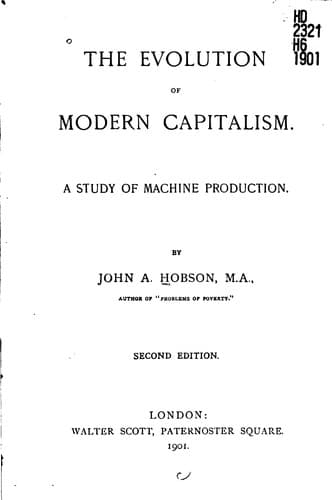
The Evolution of Modern Capitalism: A Study of Machine ProductionHobson, J. A. (John Atkinson)
History
The Evolution of Modern Capitalism: A Study of Machine Production
Hobson, J. A. (John Atkinson)
Capitalism; Industries -- History; Machinery in the workplace
General Walker apparently holds that stored food used to support
productive work is capital in whosoever hands it lies. (_Political
Economy_, 2nd edit., § 87.) He is, however, concerned with
illustrations from primitive society, and possibly might hold the food
ceased to be capital if paid over by one person to another as wages.
Hearn, on the contrary, definitely excludes consumptive goods. "The
bullock, which when living formed part of the capital of the grazier,
and when dead of the butcher, is not capital when the meat reaches the
consumer." (_Plutology_, p. 135.)
Professor Marshall defers to the commercial usage so far as to apply
the term Trade Capital to "those external things which a person uses
in his trade, either holding them to be sold for money, or applying
them to produce things that are to be sold for money." But turning to
the individual, he insists upon speaking of the necessaries he
consumes to enable him to work as "capital." "Some enjoyment is indeed
derived from the consumption of the necessaries of life which are
included under capital; but they are counted as capital because of the
work for the future which they enable people to do, and not on account
of the present pleasure which they afford." (_Principles_, 2nd edit.,
p. 125.)
These instances show that Jevons is wrong in attributing to English
economists a general acceptance of the belief that goods cease to be
capital when they come into the possession of consumers. They also
serve to explain the source of the conflict of judgment and the
confusion of expression. Economists who take it to be the end of
industrial activity to place in the possession of consumers goods
which shall satisfy their desires, regard "capital" as a convenient
term to cover those forms of wealth which are a means to this end, and
are thus logically driven to exclude all consumers' goods from
capital. This view of capital coincides with the ordinary accepted
commercial view which regards capital not from its productivity side
but from its income-yielding side. Those economists, on the other
hand, who actually, though not avowedly, take production to be the end
of industry, regard as "capital" all forms of material wealth which
are means to that end, and therefore include food, etc., productively
consumed by labourers. If work considered as distinct from enjoyment
be regarded as the end, it is reasonable enough that some term should
be used to cover all the forms of material wealth serviceable to that
end. It is, however, unfortunate that the term "capital" should be
twisted from its fairly consistent commercial use to this purpose.
Public-domain text, read in full here on John Shaqi.
Reviews
Reviews
No reviews yet
Be the first to share your thoughts on this work.
Elsewhere in the archive
Join the Discussion
Join the discussion
Sign in to leave a comment or review.
Sign InorCreate an account