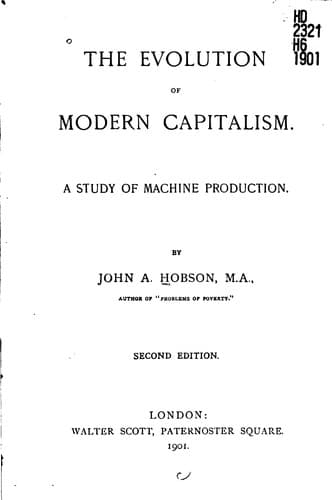
The Evolution of Modern Capitalism: A Study of Machine ProductionHobson, J. A. (John Atkinson)
History
The Evolution of Modern Capitalism: A Study of Machine Production
Hobson, J. A. (John Atkinson)
Capitalism; Industries -- History; Machinery in the workplace
Dr. Keynes,[170] who seems to think the sole difficulty as regards the
definition of capital arises from the difference in the point of view
of the individual and of the community, suggests the use of two terms,
"revenue capital" and "production capital." But these terms are doubly
unsatisfactory. In the first place, the "productive consumption"
economist might fairly claim that as his food, etc., enabled the
workman to obtain his wages or revenue, they belonged to revenue
capital. On the other hand, regarding it as essential to distinct
terminology to sever entirely consumptive goods from productive goods,
I should insist that the "production capital" of the community was
synonymous with its "revenue capital," and that although the
individual view of capital is not always coincident with the
community's view, that difference cannot be expressed by the
distinction of "revenue capital" and "production capital."
Moreover, the consumptive-production economists, to be consistent and
to preserve the continuity of the conception of economic activity,
would do well to abolish labour-power as a separate factor, and to
include the body of the labourer with its store of productive energy
as a species of capital. For it is urged (_e.g._, by Professor
Marshall) that the fact that the food consumed by labourers enables
them to earn an income entitles it to rank as capital. In that case
the "wages" which form that income should rank as interest upon the
capital. Again, there is no reason for breaking the continuity of the
capital at the time when the "food" is actually eaten. The food is not
destroyed, but built up into the frame of the labourer as a fund of
productive energy. If consumptive goods are once admitted as capital,
the labourer's body must be likewise capital yielding interest in the
shape of wages. If the other factor "natural agents" be still retained
(an unnecessary proceeding, since all land, etc., which is
productively serviceable is so by reason of the application of some
element of stored labour, and may therefore be called "capital"),
labour could be resolved into natural agents (the infant body) and
capital (the food, etc., used to strengthen and support the body).
Wages could then be reckoned partly as rent, partly as interest. It is
difficult to understand why "productive-consumption" economists, some
of whom have evidently contemplated the change of terminology, have
refused to take a step which would at any rate have the merit of
imparting consistency to their terminology. It is, of course, true
that no "productive-consumption" economist would straightly admit
production not consumption to be the economic goal, but his
terminology can only approximate to consistency upon this supposition.
Public-domain text, read in full here on John Shaqi.
Reviews
Reviews
No reviews yet
Be the first to share your thoughts on this work.
Elsewhere in the archive
Join the Discussion
Join the discussion
Sign in to leave a comment or review.
Sign InorCreate an account