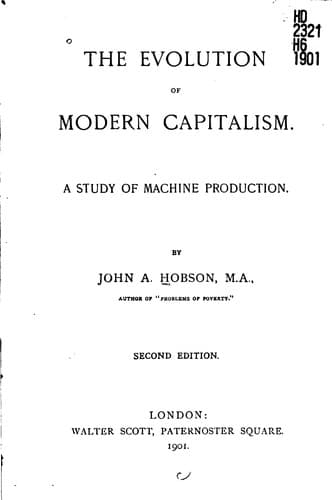
The Evolution of Modern Capitalism: A Study of Machine ProductionHobson, J. A. (John Atkinson)
History
The Evolution of Modern Capitalism: A Study of Machine Production
Hobson, J. A. (John Atkinson)
Capitalism; Industries -- History; Machinery in the workplace
"OVER-CONSUMPTION" CONSIDERED AS CAUSE OF DEPRESSION.
It is of course quite possible that a temporary over-production in one
or several trades may be explained by a correspondent under-production
in others--that is to say, there may be a misplacement of industrial
enterprise. But this can afford no explanation of the phenomenon
Depression of Trade, which consists in a general or net over-supply of
capital, as evidenced by a general fall of prices.
In like manner it is possible to explain a commercial crisis in a
single country, or part of a commercial community, as the reaction or
collapse following an attempt to increase the quantity of fixed
capital out of proportion to the growth of the current national
income, by a reckless borrowing. This attempt of a single country to
enlarge its business operations beyond the limits of the possible
savings of its own current income, Mr. Bonamy Price and M. Yves Guyot
speak of under the questionable title of Over-consumption. Since they
tender this vice of over-consumption as the true and sufficient
explanation of commercial crises, it is necessary to examine the
position.
Professor Bonamy Price applied the following analysis to the great
crisis in the United States of 1877:--
"We are now in a position to perceive the magnitude of the blunder of
which the American people were guilty in constructing this most
mischievous quantity of fixed capital in the form of railways. They
acted precisely like a landowner who had an estate of £10,000 a year,
and spent £20,000 on drainage. It could not be made out of savings,
for they did not exist, and at the end of the very first year he must
sell a portion of the estate to pay for the cost of his draining. In
other words, his capital, his estate, his means of making income
whereon to live was reduced. The drainage was an excellent operation,
but for him it was ruinous. So it was with America. Few things in the
long run enrich a nation like railways; but so gigantic an
over-consumption, not out of savings, but out of capital, brought her
poverty, commercial depression, and much misery. The new railways have
been reckoned at some 30,000 miles, at an estimated cost of £10,000 a
mile; they destroyed three hundred million of pounds worth, not of
money, but of corn, clothing, coal, iron, and other substances. The
connection between such over-production and commercial depression is
here only too visibly that of parent and child. But the disastrous
consequences were far from ending here. The over-consumption did not
content itself with the wealth used up in working the railways and the
materials of which they were composed. It sent other waves of
destruction rolling over the land. The demand for coal, iron, engines,
and materials kindled prodigious excitement in the factories and the
shops; labourers were called for from every side; wages rose rapidly;
profits shared the upward movement; luxurious spending overflowed;
Public-domain text, read in full here on John Shaqi.
Reviews
Reviews
No reviews yet
Be the first to share your thoughts on this work.
Elsewhere in the archive
Join the Discussion
Join the discussion
Sign in to leave a comment or review.
Sign InorCreate an account