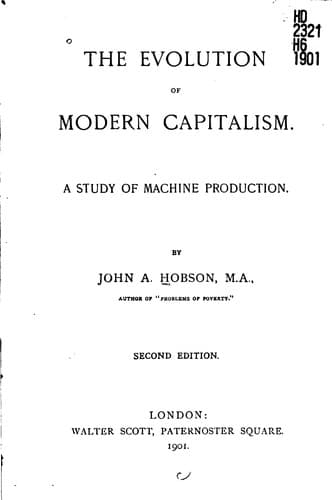
The Evolution of Modern Capitalism: A Study of Machine ProductionHobson, J. A. (John Atkinson)
History
The Evolution of Modern Capitalism: A Study of Machine Production
Hobson, J. A. (John Atkinson)
Capitalism; Industries -- History; Machinery in the workplace
prices advanced all round; the recklessness of a prosperous time
bubbled over; and this subsidiary over-consumption immensely enlarged
the waste of the national capital set in motion by the expenditure on
the railways themselves. Onward still pressed the gale; foreign
nations were carried away by its force. They poured their goods into
America, so over-powering was the attraction of high prices. They
supplied materials for the railways, and luxuries for their
constructors. Their own prices rose in turn; their business burst into
unwonted activity; profits and wages were enlarged; and the vicious
cycle repeated itself in many countries of Europe. Over-consumption
advanced with greater strides; the tide of prosperity rose ever
higher; and the destruction of wealth marched at greater speed."[172]
Now, in the first place, our analysis of saving and the confinement of
the term consumption to direct embodiments of utility and convenience
forbid us to acknowledge that the action of the United States or the
analogy of the improving landowner is a case of over-consumption at
all. If the landowner borrowed money on his estates in order to live
in luxury for a season beyond his income, or similarly, if a State
raised loans in order to consume powder and shot, the term
over-consumption rightly applies. But where the landowner borrows so
much money to improve his land that he is unable to hold out till the
improvements bear fruit, and must sell his land to pay the interest,
he is not rightly accused of over-consumption. His reduced consumption
later on while practising retrenchment is simply a process of "saving"
which, when complete, is to take the place of an amount of "saving"
previously made by some one else and borrowed by him. What happened
was simply this. A, wishing to drain his land, had not "saved" enough
to do it; B has saved, and A, borrowing his "saving," holds it for a
time in his shape of drainage. If he can continue to pay interest and
gradually "save" to pay off the capital, he will do so; if not, as in
the case supposed, B, the mortgagee, will foreclose and legally enter
upon his savings in the shape of "drainage" which he really owned all
along. But even if A in this case were rightly accused of
over-consumption, this over-consumption must be considered as balanced
by the under-consumption of B, so that as regards the community of
which A and B are both members there is no over-consumption.
Public-domain text, read in full here on John Shaqi.
Reviews
Reviews
No reviews yet
Be the first to share your thoughts on this work.
Elsewhere in the archive
Join the Discussion
Join the discussion
Sign in to leave a comment or review.
Sign InorCreate an account