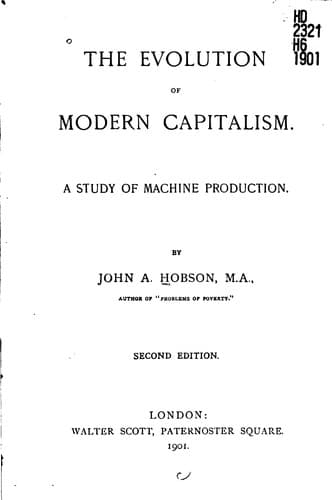
The Evolution of Modern Capitalism: A Study of Machine ProductionHobson, J. A. (John Atkinson)
History
The Evolution of Modern Capitalism: A Study of Machine Production
Hobson, J. A. (John Atkinson)
Capitalism; Industries -- History; Machinery in the workplace
§ 1. _The Influence of Machinery upon the number of Employed,
dependent on "elasticity of demand."_
§ 2. _Measurement of direct effects on Employment in Staple
Manufactures._
§ 3. _Effects of Machinery in other Employments--The Evidence
of French Statistics._
§ 4. _Influence of Introduction of Machinery upon Regularity of
Employment._
§ 5. _Effects of "Unorganised" Machine-industry upon Regularity._
§ 6. _Different Ways in which modern Industry causes Unemployment._
§ 7. _Summary of General Conclusions._
§ 1. In discussing the direct influences of machinery upon the
economic position of the labourer we must distinguish its effects upon
(1) the number of workers employed; (2) the regularity of employment;
(3) the skill, duration, intensity, and other qualities of labour; (4)
the remuneration of labour. Though these influences are closely
related in complex interaction, it is convenient to give a separate
consideration to each.
(1) _Effects of Machinery upon the number of Employed._--The motive
which induces capitalist employers to introduce into an industry
machinery which shall either save labour by doing work which labour
did before, or assist labour by making it more efficient, is a desire
to reduce the expenses of production. A new machine either displaces
an old machine, or it undertakes a process of industry formerly done
by hand labour without machinery.
In the former case it has been calculated that the expenses incurred
in making, maintaining, and working the new machines so as to produce
a given output will be less than the corresponding expenses involved
in the use of the old machines. Assuming that the labour of making and
working the new machines is paid at no lower rate than the labour it
displaces, and that the same proportion of the price of each machine
went as wages and as profits, it must follow that the reduction of
expenses achieved signifies a net displacement of labour for a given
quantity of production. Since the skilled labour of making new
machines is likely to be paid higher than that of making more old
machines, and the proportion of the price which goes as profit upon a
new invention will be higher than in the case of an old one,[174] the
actual displacement of labour will commonly be larger than is
represented by the difference in money price of the two machines.
Moreover, since in the case of an old manufacturing firm the cost of
discarding a certain amount of existing machinery must be reckoned in,
the substitution of new machinery for old will generally mean a
considerable displacement of labour.
Public-domain text, read in full here on John Shaqi.
Reviews
Reviews
No reviews yet
Be the first to share your thoughts on this work.
Elsewhere in the archive
Join the Discussion
Join the discussion
Sign in to leave a comment or review.
Sign InorCreate an account