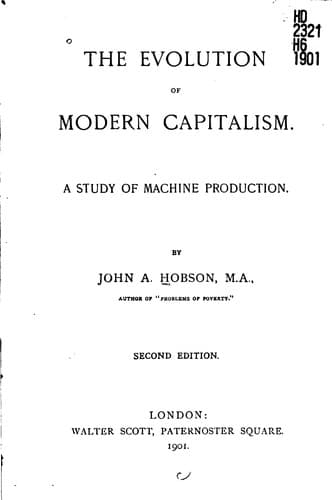
The Evolution of Modern Capitalism: A Study of Machine ProductionHobson, J. A. (John Atkinson)
History
The Evolution of Modern Capitalism: A Study of Machine Production
Hobson, J. A. (John Atkinson)
Capitalism; Industries -- History; Machinery in the workplace
[160] Chap. v. § 5.
[161] Bk. III., chap. xiv. § 3.
[162] The stock of a small retailer will not, however, in all cases
vary proportionately with the aggregate sales of all classes of goods.
A small shopkeeper, to retain his custom and credit, is often required
to keep a small stock of a large variety of goods not often in
request. If he sells them rather more quickly, he does not necessarily
increase his stock in hand at any particular time.
[163] It likewise determines the quantity of plant and stock at _a_,
_b_, _c_, _d_ down each of the perpendicular lines, for the demand at
each of these points in the production of plant and machinery is
derived from the requirements at the points A, B, C, D, E. The flow of
goods therefore up these channels, though slower in its movement
(since in the main channel only goods flow, while fixed capital is
subject to the slower "wear and tear"), is equally determined by and
derived from the consumption at F. The whole motive-power of the
mechanism is engendered at F, and the flow of money paid over the
retail counter as it passes in a reverse current from F towards A,
supplies the necessary stimulus at each point, driving the goods
another stage in their journey.
[164] Böhm-Bawerk, _Positive Theory of Capital_, p. 67. See Appendix
I. for conflict of opinion among English economists.
[165] _Principles of Political Economy_, Bk. I., chap. v. § 3; see
also Bk. III., chap. xiv. § 3.
[166] It should be noted that an increased amount of consumption in
the future does not necessarily compensate for a disturbance of the
current balance of saving and spending, for an _increased proportion
of future income_ will have to be spent in order to compensate.
[167] It must be borne in mind that many articles of utility and
enjoyment must in their final processes be produced for immediate
consumption. The "saving" of perishable goods is confined to a saving
of the more enduring forms of machinery engaged in their production,
or in some few cases to a storing up of the raw material. So likewise
that large portion of productive work termed "personal services"
cannot be antedated. These limits to the possibility of "saving" are
important. No amount of present sacrifice in the interest of the next
generation could enable them to live a life of luxurious idleness.
[168] Ruskin, _Unto this Last_, p. 145.
[169] This does not necessarily imply a stimulation of new saving. A
fuller vitality given to existing forms of capital will raise the
quantity of real capital as measured in money. Mills and machinery
which have no present or future use, though they embody saving, have
no value and do not increase real capital.
[170] _Scope and Method of Political Economy_, p. 162.
[171] _Production and Consumption_, chap. iv. § 2.
[172] _Contemporary Review_, May 1879.
[173] _Principles of Social Economy_, p. 245. (Sonnenschein.)
CHAPTER VIII.
MACHINERY AND DEMAND FOR LABOUR.
Public-domain text, read in full here on John Shaqi.
Reviews
Reviews
No reviews yet
Be the first to share your thoughts on this work.
Elsewhere in the archive
Join the Discussion
Join the discussion
Sign in to leave a comment or review.
Sign InorCreate an account