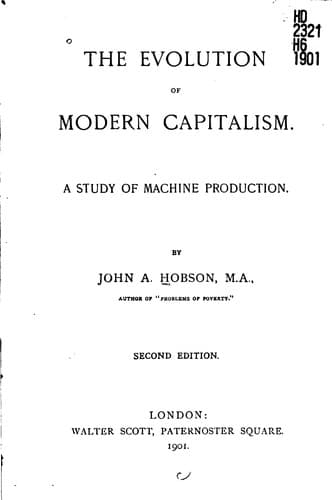
The Evolution of Modern Capitalism: A Study of Machine ProductionHobson, J. A. (John Atkinson)
History
The Evolution of Modern Capitalism: A Study of Machine Production
Hobson, J. A. (John Atkinson)
Capitalism; Industries -- History; Machinery in the workplace
"In carpet weaving fifty years ago the workman drove the shuttle with
the hand, and produced from forty-five to fifty yards per week, for
which he was paid from 9d. to 1s. per yard, while at the present day a
girl attending a steam loom can produce sixty yards a day, and does
not cost her employer 1-1/2d. per yard for her labour. That girl with
her loom is now doing the work of eight men. The question is, How are
these men employed now? In a clothier's establishment, seeing a girl
at work at a sewing machine, he asked the employer how many men's
labour that machine saved him. He said it saved him twelve men's
labour. Then he asked, 'What would those twelve men be doing now?'
'Oh,' he said, 'they will be much better employed than if they had
been with me, perhaps at some new industry.' He asked, 'What new
industry?' But the employer could not point out any except
photography; at last he said they would probably have found employment
in making sewing machines. Shortly afterwards he was asked to visit
the American Singer Sewing Machine Factory, near Glasgow. He got this
clothier to accompany him, and when going over the works they came
upon the very same kind of machines as the clothier had in his
establishment. Then he put the question to the manager, 'How long
would it take a man to make one of these machines?' He said he could
not tell, as no man made a machine; they had a more expeditious way of
doing it than that--there would be upwards of thirty men employed in
the making of one machine; but he said 'if they were to make this
particular kind of machine, they would turn out one for every four
and a half days' work of each man in their employment.' Now, there was
a machine that with a girl had done the work of twelve men for nearly
ten years, and the owner of that machine was under the impression that
these twelve men would be employed making another machine, while four
and a half days of each of these men was sufficient to make another
machine that was capable of displacing other twelve men."
In cases like the above we must, of course, bear in mind that a
diminution in employment in the several manufacturing processes
directly and indirectly engaged in forwarding an industry, is not of
itself conclusive evidence that the machinery has brought about a net
displacement of labour. If the output is increased the employment in
the extractive, the transport, and the various distributing processes
may compensate the reduction in making goods and machinery.
Public-domain text, read in full here on John Shaqi.
Reviews
Reviews
No reviews yet
Be the first to share your thoughts on this work.
Elsewhere in the archive
Join the Discussion
Join the discussion
Sign in to leave a comment or review.
Sign InorCreate an account