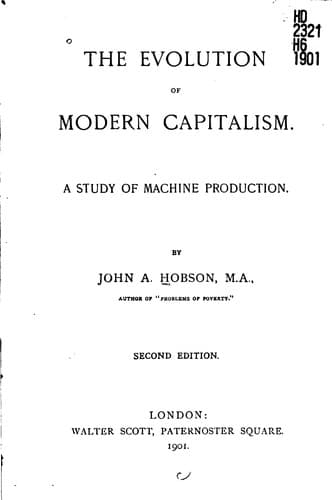
The Evolution of Modern Capitalism: A Study of Machine ProductionHobson, J. A. (John Atkinson)
History
The Evolution of Modern Capitalism: A Study of Machine Production
Hobson, J. A. (John Atkinson)
Capitalism; Industries -- History; Machinery in the workplace
§ 2. The industrial history of a country like England can furnish no
sufficient data for a conclusive general judgment of the case. The
enormous expansion of production induced by the application of
machinery in certain branches of textile industry during the first
half of this century indisputably led to an increased demand for
English labour in trades directly or indirectly connected with textile
production. But, in the first place, this cannot be regarded as a
normal result of a fall of prices due to textile machinery, but is
largely attributable to an expansion in the area of consumption--the
acquisition of vast new markets--in which greater efficiency and
cheapness of transport played the most considerable part. Secondly,
assuming that the more pressing needs of the vast body of consumers
are already satisfied by machine-made textile goods, we are not at
liberty to conjecture that any further cheapening of goods, owing to
improved machinery, will have a correspondent effect on consumption
and the demand for labour. If England had been a self-contained
country, manufacturing only for her own market, the result of
machinery applied to textile industries would without doubt have been
a considerable net displacement of textile labour, making every
allowance for growth of population and increased home consumption. The
expansion of English production under the rapid development of
machinery in the nineteenth century cannot therefore be taken as a
right measure of the normal effects of the application of machinery.
What direct evidence we have of the effect of machinery upon demand
for labour is very significant. Mr. Charles Booth, in his _Occupations
of the People_, presents an analysis of the census returns, showing
the proportion of the population engaged in various employments at
decennial points from 1841 to 1881. To these may be added such
statistics of the 1891 census as the present condition of their
presentation allows us to relate to the former censuses.[177] If we
turn to manufactures, upon which, together with transport, machinery
exercises the most direct influence, we find that the aggregate of
manufactures shows a considerable increase in demand for labour up to
1861--that is, in the period when English wares still kept the lead
they had obtained in the world market--but that since 1861 there is a
positive decline in the proportion of the English population employed
in manufactures. The percentages up to 1881 run as follows:--
1841[178] 27.1 per cent.
1851 32.7 "
1861 33.0 "
1871 31.6 "
1881 30.7 "
Public-domain text, read in full here on John Shaqi.
Reviews
Reviews
No reviews yet
Be the first to share your thoughts on this work.
Elsewhere in the archive
Join the Discussion
Join the discussion
Sign in to leave a comment or review.
Sign InorCreate an account