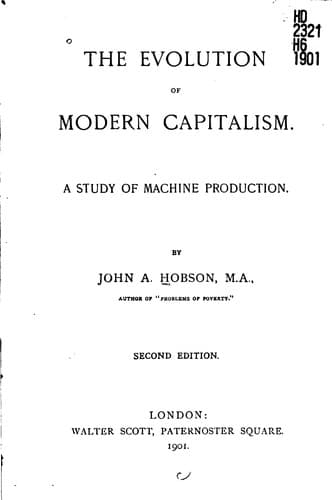
The Evolution of Modern Capitalism: A Study of Machine ProductionHobson, J. A. (John Atkinson)
History
The Evolution of Modern Capitalism: A Study of Machine Production
Hobson, J. A. (John Atkinson)
Capitalism; Industries -- History; Machinery in the workplace
No. of Spindles. No. of Looms. No. of Operatives.
1850 20,977,817 249,627 330,924
1878 44,206,690 514,911 482,903
More recent statistics show that the relative diminution of employment
in textile industries traceable since 1851, became a positive
diminution after 1871, though the statistics of 1891 indicate a
certain recovery.
1841 618,509[180]
1851 603,800
1861 934,500
1871 970,000
1881 962,000
1891 1,016,100[181]
The significance of these figures in relation to the demand for labour
receives further emphasis when the large and rapid displacement of
male by female labour is taken into account. In the dress trades it
may be observed that the absolute increase which every census, save
that of 1871, discloses, is absorbed by the tailoring and millinery
branches, where machinery plays a relatively unimportant part, and
that in the boot and shoe trade, where there has been a greatly
increased application of machinery, there has been not only a
proportionate but an absolute fall-off of employment in the twenty
years following 1861, though the 1891 census again brings up the
absolute numbers of the boot and shoe trade to a little above the
level of 1851.[182]
The branches of manufacture which show a large increase in the
proportion of employment they give in 1891 as compared with 1861 are
machinery and tools, printing and bookbinding, wood furniture and
carriages, fuel, gas, chemicals, and unspecified trades (chiefly
connected with machinery). Machinery and tools alone, among the larger
manufactures, yield a large proportionate increase of employment,
amounting, according to the Census Report, to 27.7 per cent. between
1881 and 1891, though dealers are included in this estimate as well as
makers.
From these facts two conclusions may be drawn regarding the direct
effects of machinery. First, so far as the aggregate of manufactures
is concerned, the net result of the increased use of machinery has not
been to offer an increased demand for labour in these industries
commensurate with the growth of the working population. Second, an
increased proportion of the manufacturing population is employed
either in those branches of the large industries where machinery is
least used, or in the smaller manufactures which are either subsidiary
to the large industries, or are engaged in providing miscellaneous
comforts and luxuries.
§ 3. When we turn from manufactures to other employments, we perceive
that while mining and building employ an increasing proportion of the
working classes since 1851, agriculture offers a rapidly diminishing
employment, descending from 20.9 per cent. in 1851 to 11.5 per cent.
in 1881, and 9.9 in 1891.[183]
Public-domain text, read in full here on John Shaqi.
Reviews
Reviews
No reviews yet
Be the first to share your thoughts on this work.
Elsewhere in the archive
Join the Discussion
Join the discussion
Sign in to leave a comment or review.
Sign InorCreate an account