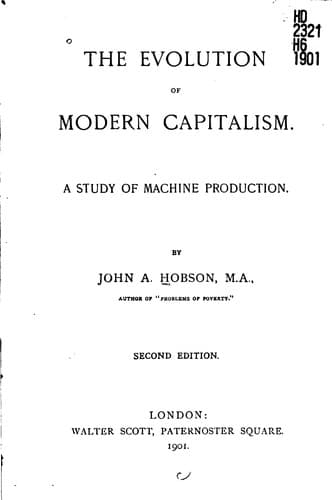
The Evolution of Modern Capitalism: A Study of Machine ProductionHobson, J. A. (John Atkinson)
History
The Evolution of Modern Capitalism: A Study of Machine Production
Hobson, J. A. (John Atkinson)
Capitalism; Industries -- History; Machinery in the workplace
If we take the staple manufactures, employing the largest number of
workers, we shall find that for the most part they show a rising
demand for labour up to 1861, a stationary or falling demand when
compared with the population after that date. The foundational
industries--machinery and tools, shipbuilding, metal working--whose
demand for labour during the period 1841-61 increased by leaps and
bounds, still show in the aggregate an increased proportion of
employment, largely due to the rise since 1861 of a large export
trade in machinery. But while the machine-making industries continue
to grow faster than the population in the employment they give,
increasing from 209,353 in 1881 to 262,910 in 1891, and shipbuilding
also gives a proportionate increase, it is noteworthy that the steel
and iron trades, which up to 1871 grew far faster than the population,
began to show signs of decline. In 1881 the number of steel and iron
workers was 361,343, in 1891 it had increased to 380,193, a growth of
only 5.3 per cent. as compared with a growth of population amounting
to 11.7 per cent., and a growth of the number of occupied persons
amounting to 15.3 per cent.
Fuel, gas, chemicals, and other general subsidiary trades show a
steady advance in proportionate employment. The textile and dyeing
industries, on the other hand, showing an increased proportion of
employment up to 1851, by which time the weaving industry was taken
over by machinery, present a continuous and startling decline in the
proportion of employment since that date. A considerably smaller
proportion of the employed classes are now engaged in these trades
than in 1841. The dressmaking industries give the same result--a
continuous decline in proportion of employment since 1851, though in
this case the 1891 figures indicate a slight recovery. The following
are the percentages:--
Textile and
Dyeing. Dress.
1841 9.1 7.8
1851 11.1 10.3
1861 10.2 9.8
1871 9.3 8.5
1881 8.2 8.1
1891 7.6 8.3
The failure of demand for labour to keep pace in its growth with the
growth of population in the main branches of the spinning and weaving
industries is emphasised by Mr. Ellison. Comparing 1850 with 1878, he
says:--"In spinning-mills there is an increase of about 189 per cent.
in spindles, but only 63 per cent. in hands employed; and in weaving
mills an increase of 360 per cent. in looms, but only 253 per cent. in
operatives. This, of course, shows that the machinery has become more
and more automatic or self-regulating, thus requiring the attendance
of a relatively smaller number of workers."[179] When the subsidiary
branches of textile industry are added the results point still more
conclusively in the same direction.
Public-domain text, read in full here on John Shaqi.
Reviews
Reviews
No reviews yet
Be the first to share your thoughts on this work.
Elsewhere in the archive
Join the Discussion
Join the discussion
Sign in to leave a comment or review.
Sign InorCreate an account