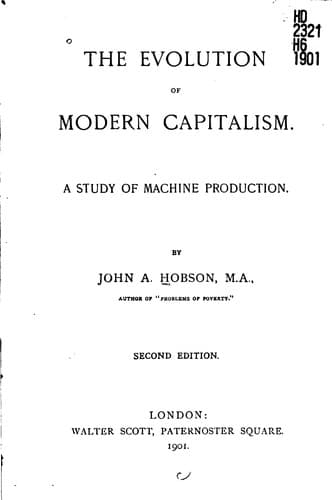
The Evolution of Modern Capitalism: A Study of Machine ProductionHobson, J. A. (John Atkinson)
History
The Evolution of Modern Capitalism: A Study of Machine Production
Hobson, J. A. (John Atkinson)
Capitalism; Industries -- History; Machinery in the workplace
French statistics during the last half century indicate the same
general movement so far as employment is concerned, though the
movement is less regular.
There is the same decline in the proportion of those engaged in
agriculture, though less rapid than in England, the same shrinkage of
the proportion engaged in manufacture, and generally in "making"
industries, and the same notable expansion of the "dealing" classes. A
rapid growth of the professional and public services is common to
England and France. The following percentages mark these movements in
France:--[186]
1856. 1861. 1866. 1872. 1876. 1881. 1886.
Agricultural
classes 52.9 53.2 51.5 52.5 53.0 50.0 47.8
Industrial 29.1 27.4 28.8 24.1 25.9 25.6 25.2
Commercial 4.5 3.9 4.0 8.4 10.7 10.5 11.5[187]
Professional, }
public service, }
persons living } 9.1 9.2 9.5 11.1 10.3 10.2 11.1
on their incomes }
These facts and figures seem to support the following conclusions:--
(1) That along with the increased application of machinery to the
textile and other staple manufactures there has been in these
industries a decrease of employment relative to the growth of the
working population.
(2) That in the transport industries the increase of employment is in
inverse proportion to the introduction of machinery into the several
branches as a dominating factor.
(3) That the considerable diminution of agricultural employment is not
compensated by any proportionate increase of manufacturing employment,
but that the displaced agricultural labour finds employment in such
branches of the transport and distributive trade as are less subject
to machinery.
In the rough estimate of the effect of machinery upon employment, its
influence upon English agriculture has been left untouched by reason
of the inherent complexity of the forces which are operative. But it
must not be forgotten that by far the most important factor in the
decline of English agricultural employment is the transport machinery
which has brought the produce of distant countries into direct
competition with English agricultural produce.
Public-domain text, read in full here on John Shaqi.
Reviews
Reviews
No reviews yet
Be the first to share your thoughts on this work.
Elsewhere in the archive
Join the Discussion
Join the discussion
Sign in to leave a comment or review.
Sign InorCreate an account