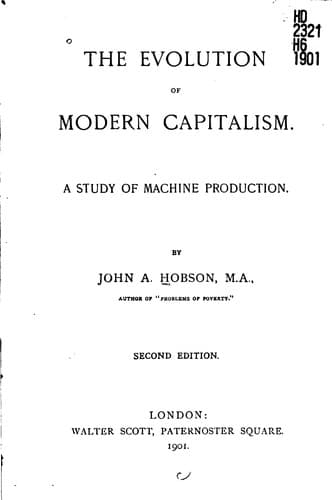
The Evolution of Modern Capitalism: A Study of Machine ProductionHobson, J. A. (John Atkinson)
History
The Evolution of Modern Capitalism: A Study of Machine Production
Hobson, J. A. (John Atkinson)
Capitalism; Industries -- History; Machinery in the workplace
So far, therefore, as the statistics of employments present a just
register of the influence of machinery upon demand for labour, we are
driven to conclude that the net influence of machinery is to diminish
employment so far as those industries are concerned into which
machinery directly enters, and to increase the demand in those
industries which machinery affects but slightly or indirectly. If this
is true of England, which, having the start in the development of the
factory system, has to a larger extent than any other country
specialised in the arts of manufacture, it is probable that the net
effect of machinery upon the demand for labour throughout the
industrial world has been to throw a larger proportion of the
population into industries where machinery does not directly enter.
This general conclusion, however, for want of exact statistical
inquiries conducted upon a single basis, can only be accepted as
probable.
§ 4. (2) _Effects of Machinery upon the Regularity of
Employment._--The influence of machinery upon regularity of employment
has a twofold significance. It has a direct bearing upon the
measurement of demand for labour, which must take into account not
only the number of persons employed, but the quantity of employment
given to each. It has also a wider general effect upon the moral and
industrial condition of the workers, and through this upon the
efficiency of labour, which is attracting increased attention among
students of industrial questions. The former consideration alone
concerns us here. We have to distinguish--(_a_) the effects of the
introduction of machinery as a disturbant of regularity of labour;
(_b_) the normal effects of machine-production upon regularity of
labour.
(_a_) The direct and first effect of the introduction of machinery is,
as we have seen, to displace labour. The machinery causes a certain
quantity of unemployment, apart from the consideration of its ultimate
effect on the number of persons to whom employment is given. Professor
Shield Nicholson finds two laws or tendencies which operate in
reducing this disturbing influence of machinery. He holds (1) that a
radical change made in the methods of production will be gradually and
continuously adopted; (2) that these radical changes--these
discontinuous leaps--tend to give place to advances by small
increments of invention.[188]
Public-domain text, read in full here on John Shaqi.
Reviews
Reviews
No reviews yet
Be the first to share your thoughts on this work.
Elsewhere in the archive
Join the Discussion
Join the discussion
Sign in to leave a comment or review.
Sign InorCreate an account