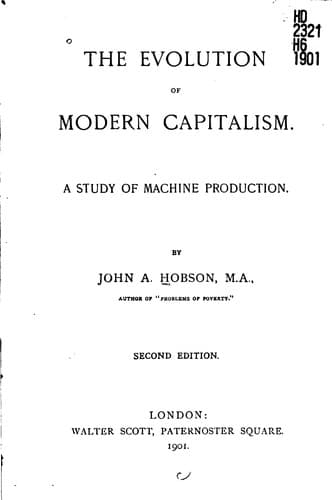
The Evolution of Modern Capitalism: A Study of Machine ProductionHobson, J. A. (John Atkinson)
History
The Evolution of Modern Capitalism: A Study of Machine Production
Hobson, J. A. (John Atkinson)
Capitalism; Industries -- History; Machinery in the workplace
Professor Nicholson's second law is, however, more speculative and
less reliable in its action. It seems to imply some absolute limit to
the number of great inventions. Radical changes are no doubt generally
followed by smaller increments of invention; but we can have no
guarantee that new radical changes quite as important as the earlier
ones may not occur in the future. There are no assignable limits to
the progress of mechanical invention, or to the rate at which that
progress may be effected. If certain preliminary difficulties in the
general application of electricity as a motor can be overcome, there
is every reason to believe that, with the improved means of rapidly
communicating knowledge we possess, our factory system may be
reorganised and labour displaced far more rapidly than in the case of
steam, and at a rate which might greatly exceed the capacity of labour
to adjust itself to the new industrial conditions. At any rate we are
not at liberty to take for granted that the mobility of labour must
always keep pace with the application of new and labour-disturbing
inventions. Since we are not able to assume that the market will be
extended _pari passu_ with the betterment in methods of production, it
is evident that improvements in machinery must be reckoned as a normal
cause of insecurity of employment. The loss of employment may be only
"temporary," but as the life of a working man is also temporary, such
loss may as a disturbing factor in the working life have a
considerable importance.
Public-domain text, read in full here on John Shaqi.
Reviews
Reviews
No reviews yet
Be the first to share your thoughts on this work.
Elsewhere in the archive
Join the Discussion
Join the discussion
Sign in to leave a comment or review.
Sign InorCreate an account