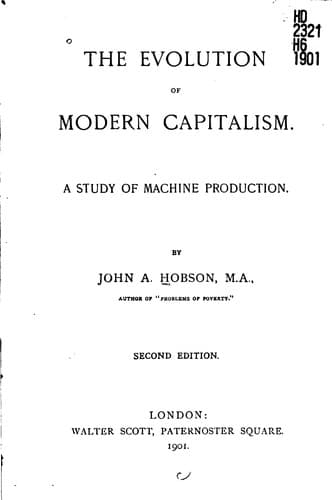
The Evolution of Modern Capitalism: A Study of Machine ProductionHobson, J. A. (John Atkinson)
History
The Evolution of Modern Capitalism: A Study of Machine Production
Hobson, J. A. (John Atkinson)
Capitalism; Industries -- History; Machinery in the workplace
§ 5. (_b_) Whether machinery, apart from the changes due to its
introduction, favours regularity or irregularity of employment, is a
question to which a tolerably definite answer can be given. The
structure of the individual factory, with its ever-growing quantity of
expensive machinery, would seem at first sight to furnish a direct
guarantee of regular employment, based upon the self-interest of the
capitalist. Some of the "sweating" trades of London are said to be
maintained by the economy which can be effected by employers who use
no expensive plant or machinery, and who are able readily to increase
or diminish the number of their employees so as to keep pace with the
demands of some "season" trade, such as fur-pulling or artificial
flowers. When the employer has charge of enormous quantities of fixed
capital, his individual interest is strongly in favour of full and
regular employment of labour. On this account, then, machinery would
seem to favour regularity of employment. On the other hand, Professor
Nicholson has ample evidence in support of his statement that "great
fluctuations in price occur in those commodities which require for
their production a large proportion of fixed capital. These
fluctuations in prices are accompanied by corresponding fluctuations
in wages and irregularity of employment."[192] In a word, while it is
the interest of each producer of machine-made goods to give regular
employment, some wider industrial force compels him to irregularity.
What is this force? It is uncontrolled machinery. In the several units
of machine-production, the individual factories or mills, we have
admirable order and accurate adjustment of parts; in the aggregate of
machine-production we have no organisation, but a chaos of haphazard
speculation. "Industry has not yet adapted itself to the changes in
the environment produced by machinery." That is all.
Under a monetary system of commerce, though commodities still exchange
for commodities, it is an essential condition of that exchange that
those who possess purchasing power shall be willing to use a
sufficient proportion of it to demand consumptive goods. Otherwise the
production of productive goods is stimulated unduly while the demand
for consumptive goods is checked,--the condition which the business
man rightly regards as over-supply of the material forms of capital.
When production was slower, markets[193] narrower, credit less
developed, there was less danger of this big miscalculation, and the
corrective forces of industry were more speedily effective. But modern
machinery has enormously expanded the size of markets, the scale of
competition, the complexity of demand, and production is no longer for
a small, local, present demand, but for a large, world, future demand.
Hence machinery is the direct material cause of these great
fluctuations which bring, as their most evil consequence, irregularity
of wages and employment.
Public-domain text, read in full here on John Shaqi.
Reviews
Reviews
No reviews yet
Be the first to share your thoughts on this work.
Elsewhere in the archive
Join the Discussion
Join the discussion
Sign in to leave a comment or review.
Sign InorCreate an account