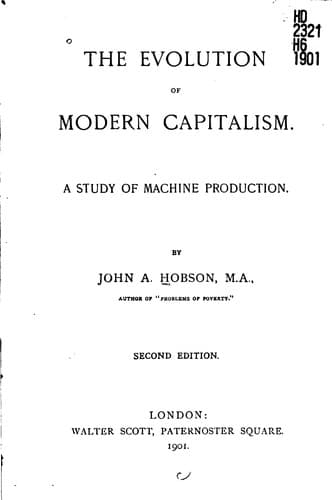
The Evolution of Modern Capitalism: A Study of Machine ProductionHobson, J. A. (John Atkinson)
History
The Evolution of Modern Capitalism: A Study of Machine Production
Hobson, J. A. (John Atkinson)
Capitalism; Industries -- History; Machinery in the workplace
§ 6. But there is also another force which, in England at any rate,
under the increased application of machinery, makes for an increase
rather than a diminution of speculative production. It has been seen
that the proportion of workers engaged in producing comforts and
luxuries is growing, while the proportion of those producing the prime
necessaries of life is declining. How far the operation of the law of
diminishing returns will allow this tendency to proceed we cannot here
discuss. But statistics show that this is the present tendency both in
England and in the United States. Now the demand for comforts and
luxuries is essentially more irregular and less amenable to
commercial calculation than the demand for necessaries. The greatest
economies of machine-production are found in industries where the
demand is largest, steadiest, and most calculable. Hence the effect of
machinery is to drive ever and ever larger numbers of workers from the
less to the more unsteady employments. Moreover, there is a marked
tendency for the demand for luxuries to become more irregular and less
amenable to calculation, and a corresponding irregularity is imposed
upon the trades engaged in producing them. Twenty years ago it was
possible for Coventry ribbon-weavers to "make to stock" during the
winter months, for though silk ribbons may always be classed as a
luxury, certain patterns commanded a tolerably steady sale year after
year. Now the fluctuations of fashion are much sharper and more
frequent, and a far larger proportion of the consumers of ribbons are
affected by fashion-changes. Hence it has become more and more
difficult to forecast the market, less and less is made to stock, more
and more to order, and orders are given at shorter and shorter notice.
So looms and weavers kept idle during a large part of the year are
driven into fevered activity of manufacture for short irregular
periods. The same applies to many other season and fashion trades. The
irregularity of demand prevents these trades from reaping the full
advantages of the economies of machinery, though the partial
application of machinery and power facilitates the execution of orders
at short notice. Hence the increased proportion of the community's
income spent on luxuries requires an increased proportion of the
labour of the community to be expended in their production. This
signifies a drifting of labour from the more steady forms of
employment to those which are less steady and whose unsteadiness is
constantly increasing. A larger proportion of town workers is
constantly passing into trades connected with preparing and preserving
animal and vegetable substances, to such industries as the hat and
bonnet, confectionery, bookbinding, trades affected by weather,
holiday and season trades, or those in which changes in taste and
fashion are largely operative.
Public-domain text, read in full here on John Shaqi.
Reviews
Reviews
No reviews yet
Be the first to share your thoughts on this work.
Elsewhere in the archive
Join the Discussion
Join the discussion
Sign in to leave a comment or review.
Sign InorCreate an account