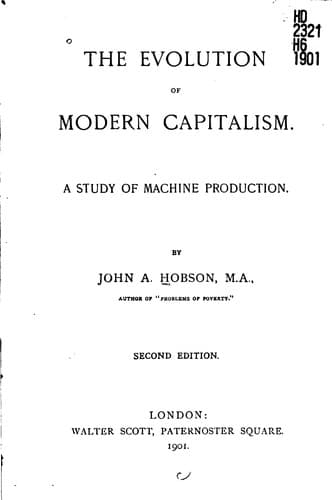
The Evolution of Modern Capitalism: A Study of Machine ProductionHobson, J. A. (John Atkinson)
History
The Evolution of Modern Capitalism: A Study of Machine Production
Hobson, J. A. (John Atkinson)
Capitalism; Industries -- History; Machinery in the workplace
Thus it appears there are three modes in which modern capitalist
methods of production cause temporary unemployment. (1) Continual
increments of labour-saving machinery displace a number of workers,
compelling them to remain wholly or partially unemployed, until they
have "adjusted" themselves to the new economic conditions. (2)
Miscalculation and temporary over-production, to which machine
industries with a wide unstable market are particularly prone, bring
about periodic deep depressions of "trade," temporarily throwing out
of work large bodies of skilled and unskilled labour. (3) Economies of
machine-production in the staple industries drive an increasing
proportion of labour with trades which are engaged in supplying
commodities, the demand for which is more irregular, and in which
therefore the fluctuations in demand for labour must be greater.
Most economists, still deeply imbued with a belief in the admirable
order and economy of "the play of economic forces," appear to regard
all unemployment not assignable to individual vice or incapacity as
the natural and necessary effect of the process of adjustment by which
industrial progress is achieved, ignoring altogether the two latter
classes of consideration. There is, however, reason to believe that in
an average year a far larger number of the "unemployed" at any given
time owe their unemployment to a temporary depression of the trade in
which they are engaged, than to the fluctuations brought about by
organic changes in the economic structure of the trade.
The size and importance of the "unemployment" due primarily to trade
depressions is very imperfectly appreciated. The following statistics
of the condition of the skilled labour market in the period 1886-92,
based upon the reports of twenty-two trades unions, have an important
bearing on this point:--
Year. Percentage out of work.
1886 10.1 per cent.[195]
1887 8.6 "
1888 4.4 "
1889 1.8 "
1890 2.6 "
1891 4.45 "
1892 7.33 "
1893 7.9[196] "
When it is remembered that these figures apply only to the
well-organised trades unions, which, as a rule, comprise the best and
most highly-skilled workers in the several trades, who are less likely
than others to be thrown out in a "slack time," that the building and
season trades are not included in the estimate, and that women's
industries, notoriously more irregular than men's, are altogether
ignored, it will be evident that these statistics very inadequately
represent the proportion of unemployment for the aggregate of the
working classes at the several periods. The _Report on Principal and
Minor Textile Trades_ deducts 10 per cent. from the normal wages to
represent unemployment, though the year 1885, to which the figures
refer, is spoken of as "fairly representative of a normal year."[197]
Public-domain text, read in full here on John Shaqi.
Reviews
Reviews
No reviews yet
Be the first to share your thoughts on this work.
Elsewhere in the archive
Join the Discussion
Join the discussion
Sign in to leave a comment or review.
Sign InorCreate an account