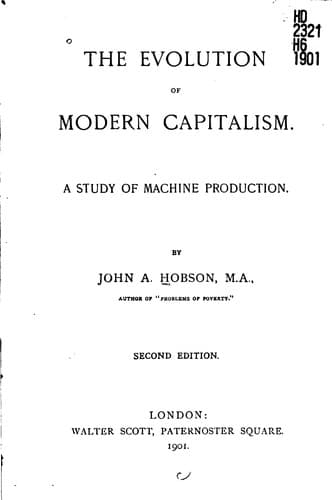
The Evolution of Modern Capitalism: A Study of Machine ProductionHobson, J. A. (John Atkinson)
History
The Evolution of Modern Capitalism: A Study of Machine Production
Hobson, J. A. (John Atkinson)
Capitalism; Industries -- History; Machinery in the workplace
(3) To the supply of new forms of wealth, which are either (_a_)
wholly non-material--_i.e._, intellectual, artistic, or other personal
services; (_b_) partly non-material--_e.g._, works of art or skill,
whose value consists chiefly in the embodiment of individual taste or
spontaneous energy, or (_c_) too irregular or not sufficiently
extended in demand to admit the application of machinery. The learned
professions, art, science, and literature, and those branches of
labour engaged in producing luxuries and luxurious services furnish a
constantly increasing employment, though the supply of labour is so
notoriously in excess of the demand in all such employments that a
large percentage of unemployment is chronic.
So long then as a community grows in numbers, so long as individuals
desire to satisfy more fully their present wants and continue to
develop new wants, forming a higher or more intricate standard of
consumption, there is no evidence to justify the conclusion that
machinery has the effect of causing a net diminution in demand for
labour, though it tends to diminish the proportion of employment in
the "manufacturing" industries; but there is strong reason to believe
that it tends to make employment more unstable, more precarious of
tenure, and more fluctuating in market value.
FOOTNOTES:
[174] Against this we may set the possibility of a fall in the rate of
interest at which manufacturers may be able to borrow capital in order
to set up improved machinery. Where an economy can be effected in this
direction, the displacement of labour due to the introduction of
machinery may not be so large--_i.e._, it will pay a manufacturer to
introduce a new machine which only "saves" a small amount of money, if
he can effect the change at a cheap rate of borrowing. (Cf. Marshall,
_Principles of Economics_, 2nd edit., pp. 569, 570.)
[175] Leone Levi, _Work and Pay_, p. 28.
[176] Statement by Mr. Shaftoe, President of the Trades Union
Congress, 1888; cf. Carroll D. Wright, _Report on Industrial
Depressions_, Washington, 1886, pp. 80-90.
[177] The merging of retail dealers with the "making" classes, the
classification of merchants with those engaged in transport
industries, and certain departures from precedent in the mode of
classification, render a full use of the 1891 figures impossible at
present.
[178] In the years 1831-41 there was an enormous increase of the
factory population. Between 1835 and 1839, according to Porter, the
increase amounted to 68,263, or a rise of 19.2 per cent. (_Progress of
the Nation_, p. 78.)
[179] T. Ellison, _Cotton Trade of Great Britain_, p. 74.
[180] Only 349,452, or 56.8 per cent. in factories. (Porter, p. 78.)
[181] This increase since 1881 is chiefly explained by the feverish
expansion and over-production of the cotton industry. The census
return for 1891 is reduced to correspond with the earlier estimates in
Booth's _Occupations of the People_.
Public-domain text, read in full here on John Shaqi.
Reviews
Reviews
No reviews yet
Be the first to share your thoughts on this work.
Elsewhere in the archive
Join the Discussion
Join the discussion
Sign in to leave a comment or review.
Sign InorCreate an account