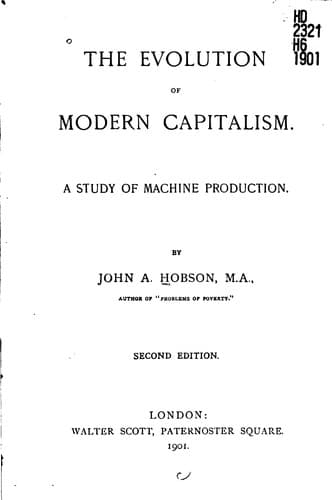
The Evolution of Modern Capitalism: A Study of Machine ProductionHobson, J. A. (John Atkinson)
History
The Evolution of Modern Capitalism: A Study of Machine Production
Hobson, J. A. (John Atkinson)
Capitalism; Industries -- History; Machinery in the workplace
The injury inflicted upon the wages, working efficiency, and character
of the working classes by irregular employment is, however, very
inadequately represented by figures indicating the average of
"unemployment" during a long period. In the first place, in such an
estimate no allowance is made for the "short time," often worked for
months together by large bodies of operatives. Secondly, in measuring
the evil of "unemployment," we must look rather to the maximum than to
the mean condition. If a man is liable to have his food supply cut off
for a month at a time, no estimate showing that on the average he has
more than enough to eat and drink will fairly represent the danger to
which he is exposed. If once in every ten years we find that some 10
per cent. of the skilled workers, and a far larger percentage of
unskilled workers, are out of employment for months together, these
figures measure the economic malady of "unemployment," which is in no
sense compensated by the full or excessive labour of periods of better
trade.
§ 7. Our reasoning from the ascertained tendencies of
machine-production points to the conclusion that, having regard to the
two prime constituents in demand for labour, the number of those
employed, and the regularity of employment, machinery does not, under
present conditions, generally favour an increased steady demand for
labour. It tends to drive an increased proportion of labour in three
directions.
(1) To the invention, construction, and maintenance of machinery to
make machines, the labour of machine-making being continually
displaced by machines, and being thus driven to the production of
machines more remote from the machines directly engaged in producing
consumptive goods. The labour thus engaged must be in an
ever-diminishing proportion to a given quantity of consumption.
Nothing but a great increase in the quantity of consumption, or the
opening of new varieties of consumption, can maintain or increase the
demand for labour in these machine-making industries.
(2) To continual specialisation, subdivision, and refinement in the
arts of distribution. The multiplication of merchants, agents,
retailers, which, in spite of forces making for centralisation in
distributive work, is so marked a feature in the English industry of
the last forty years, is a natural result of the influence of
machinery, in setting free from "making" processes an increased
proportion of labour.
Public-domain text, read in full here on John Shaqi.
Reviews
Reviews
No reviews yet
Be the first to share your thoughts on this work.
Elsewhere in the archive
Join the Discussion
Join the discussion
Sign in to leave a comment or review.
Sign InorCreate an account