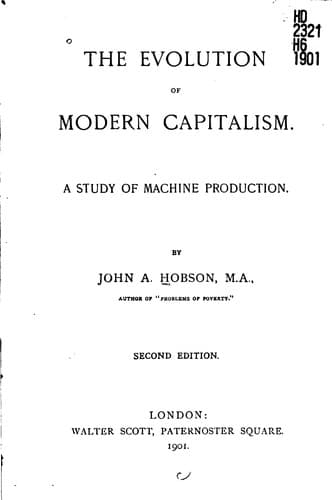
The Evolution of Modern Capitalism: A Study of Machine ProductionHobson, J. A. (John Atkinson)
History
The Evolution of Modern Capitalism: A Study of Machine Production
Hobson, J. A. (John Atkinson)
Capitalism; Industries -- History; Machinery in the workplace
§ 3. When any muscular or other physical effort is required it is
pretty evident that an increased duration or a greater continuity in
the slighter effort may tax the body quite as severely as the less
frequent or constant application of a much greater bodily force. There
can be no question but that in a competitive industrial society there
exists a tendency to compensate for any saving of hard muscular, or
other physical effort afforded by the intervention of machinery in two
ways: first, by "forcing the pace"--_i.e._, compelling the worker to
attend more machines or to work more rapidly, thus increasing the
strain, if not upon the muscles, then upon the nerves; secondly, by
extending the hours of labour. A lighter form of labour spread over an
increased period of time, or an increased number of minor muscular
exertions substituted for a smaller number of heavier exertions within
the same period of time, may of course amount to an increased tax upon
the vital energy. It is not disputed that a general result of the
factory system has been to increase the average length of the working
day, if we take under our survey the whole area of machine-production
in modern industrial communities. This is only in part attributable to
the fact that workers can be induced to sell the same daily output of
physical energy as before, while in many cases a longer time is
required for its expenditure. Another influence of equal potency is
the economy of machinery effected by working longer hours. It is the
combined operation of these two forces that has lengthened the average
working day. Certain subsidiary influences, however, also deserve
notice, especially the introduction of cheap illuminants. Before the
cheap provision of gas, the working time was generally limited by
daylight. Not until the first decade of this century was gas
introduced into cotton-mills, and another generation elapsed before it
passed in general use in manufactories and retail shops.[205] Now a
portion of nature's rest has been annexed to the working day. There
are, of course, powerful social forces making for a curtailment of the
working day, and these forces are in many industries powerfully though
indirectly aided by machinery. Perhaps it would be right to say that
machinery develops two antagonistic tendencies as regards the length
of the working day. Its most direct economic influence favours an
extension of the working hours, for machinery untired, wasting power
by idleness, favours continuous work. But when the growing pace and
complexity of highly-organised machinery taxes human energy with
increasing severity, and compresses an increased human effort within a
given time, a certain net advantage in limiting the working day for an
individual begins to emerge, and it becomes increasingly advantageous
to work the machinery for shorter hours, or, where possible, to apply
"shifts" of workers.[206]
Public-domain text, read in full here on John Shaqi.
Reviews
Reviews
No reviews yet
Be the first to share your thoughts on this work.
Elsewhere in the archive
Join the Discussion
Join the discussion
Sign in to leave a comment or review.
Sign InorCreate an account