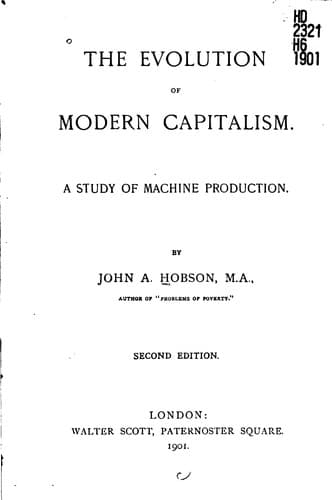
The Evolution of Modern Capitalism: A Study of Machine ProductionHobson, J. A. (John Atkinson)
History
The Evolution of Modern Capitalism: A Study of Machine Production
Hobson, J. A. (John Atkinson)
Capitalism; Industries -- History; Machinery in the workplace
But in the present stage of machine-development the economy of the
shorter working day is only obtainable in a few trades and in a few
countries; the general tendency is still in the direction of an
extended working day.[207] The full significance of this is not
confined to the fact that a larger proportion of the worker's time is
consumed in the growing monotony of production. The curtailment of his
time for consumption, and a consequent lessening of the subjective
value of his consumables, must be set off against such increase in
real wages or purchasing power as may have come to him from the
increased productive power of machinery. The value of a shorter
working day consists not merely in the diminution of the burden of
toil it brings, but also in the fact that increased consumption time
enables the workers to get a fuller use of his purchased consumables,
and to enjoy various kinds of "free wealth" from which he was
precluded under a longer working day.[208] So far as machinery has
converted handicraftsmen into machine-tenders, it is extremely
doubtful whether it has lessened the strain upon their energies,
though we should hesitate to give an explicit endorsement to Mill's
somewhat rhetorical verdict. "It is questionable if all the mechanical
inventions yet made have lightened the day's toil of any human being."
At any rate we have as yet no security that machinery, owned by
individuals who do not themselves tend it, shall not be used in such a
way as to increase the physical strain of those who do tend it. "There
is a temptation," as Mr. Cunningham says, "to treat the machine as the
main element in production, and to make it the measure of what a man
ought to do, instead of regarding the man as the first consideration,
and the machine as the instrument which helps him; the machine may be
made the primary consideration, and the man may be treated as a mere
slave who tends it."[209]
Public-domain text, read in full here on John Shaqi.
Reviews
Reviews
No reviews yet
Be the first to share your thoughts on this work.
Elsewhere in the archive
Join the Discussion
Join the discussion
Sign in to leave a comment or review.
Sign InorCreate an account