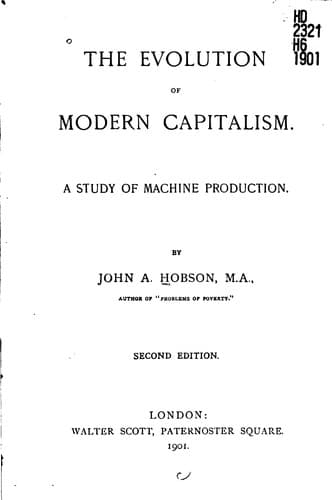
The Evolution of Modern Capitalism: A Study of Machine Production — John Shaqi
The Evolution of Modern Capitalism: A Study of Machine ProductionHobson, J. A. (John Atkinson)
History
The Evolution of Modern Capitalism: A Study of Machine Production
Hobson, J. A. (John Atkinson)
Capitalism; Industries -- History; Machinery in the workplace
So, as we tried to get the better of our colonies, still more
rigorously did we apply the same methods to foreign countries,
regarding each gain which accrued to us as an advantage which would
have wholly gone to the foreigner if we had not by firmness and
enterprise secured it for ourselves.
The slight extent of foreign intercourse was, however, partly due to
causes which are to be regarded as genuinely economic. The life and
experience of the great mass of the population of all countries was
extremely restricted; they were a scattered and rural folk whose wants
and tastes were simple, few, home-bred, and customary. The customary
standard of consumption, slowly built up in conformity with local
production, gave little encouragement to foreign trade. Moreover, to
meet the new tastes and the more varied consumption which gradually
found its way over this country, it was in conformity with the
economic theory and practice of the day to prefer the establishment of
new home industries, equipped if necessary with imported foreign
labour, to the importation of the products of such labour from abroad.
So far as England, in particular, is concerned, the attitude was
favoured by the political and religious oppression of the French
government which supplied England in the earlier eighteenth century
with a constant flow of skilled artisan labour. Many English
manufacturers profited by this flow. Our textile industries in silk,
wool, and linen, calico-printing, glass, paper, and pottery are
special beholden to the new arts thus introduced.
Among the economic barriers must be reckoned the slight development
of international credit, and of the machinery of exchange.
§ 4. These barriers, natural, political, social, economic, against
free international intercourse, throw important light upon the general
structure of world-industry in the eighteenth century.
Public-domain text, read in full here on John Shaqi.
Reviews
Reviews
No reviews yet
Be the first to share your thoughts on this work.
Join the Discussion
Join the discussion
Sign in to leave a comment or review.
Sign InorCreate an account