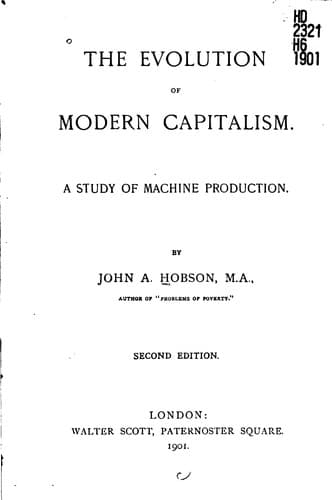
The Evolution of Modern Capitalism: A Study of Machine ProductionHobson, J. A. (John Atkinson)
History
The Evolution of Modern Capitalism: A Study of Machine Production
Hobson, J. A. (John Atkinson)
Capitalism; Industries -- History; Machinery in the workplace
So far as the man follows the machine and has his work determined for
him by mechanical necessity, the educative pressure of the latter
force must be predominant. Machinery, like everything else, can only
teach what it practises. Order, exactitude, persistence, conformity to
unbending law,--these are the lessons which must emanate from the
machine. They have an important place as elements in the formation of
intellectual and moral character. But of themselves they contribute a
one-sided and very imperfect education. Machinery can exactly
reproduce; it can, therefore, teach the lesson of exact reproduction,
an education of quantitative measurements. The defect of machinery,
from the educative point of view, is its absolute conservatism. The
law of machinery is a law of statical order, that everything conforms
to a pattern, that present actions precisely resemble past and future
actions. Now the law of human life is dynamic, requiring order not as
valuable in itself, but as the condition of progress. The law of human
life is that no experience, no thought or feeling is an exact copy of
any other. Therefore, if you confine a man to expending his energy in
trying to conform exactly to the movements of a machine, you teach him
to abrogate the very principle of life. Variety is of the essence of
life, and machinery is the enemy of variety. This is no argument
against the educative uses of machinery, but only against the
exaggeration of these uses. If a workman expend a reasonable portion
of his energy in following the movements of a machine, he may gain a
considerable educational value; but he must also have both time and
energy left to cultivate the spontaneous and progressive arts of life.
§ 5. It is often urged that the tendency of machinery is not merely
to render monotonous the activity of the individual worker, but to
reduce the individual differences in workers. This criticism finds
expression in the saying: "All men are equal before the machine." So
far as machinery actually shifts upon natural forces work which
otherwise would tax the muscular energy, it undoubtedly tends to put
upon a level workers of different muscular capacity. Moreover, by
taking over work which requires great precision of movement, there is
a sense in which it is true that machinery tends to reduce the workers
to a common level of skill, or even of un-skill.
"Whenever a process requires peculiar dexterity and steadiness of
hand, it is withdrawn as soon as possible from the cunning workman,
who is prone to irregularities of many kinds, and it is placed in
charge of a peculiar mechanism, so self-regulating that a child can
superintend it."[221]
Public-domain text, read in full here on John Shaqi.
Reviews
Reviews
No reviews yet
Be the first to share your thoughts on this work.
Elsewhere in the archive
Join the Discussion
Join the discussion
Sign in to leave a comment or review.
Sign InorCreate an account