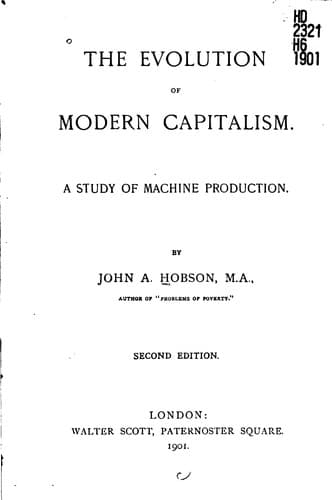
The Evolution of Modern Capitalism: A Study of Machine ProductionHobson, J. A. (John Atkinson)
History
The Evolution of Modern Capitalism: A Study of Machine Production
Hobson, J. A. (John Atkinson)
Capitalism; Industries -- History; Machinery in the workplace
That this is not true of the most highly-skilled or qualitative work
must be conceded, but it applies with great force to the bulk of
lower-skilled labour. By the aid of machinery--_i.e._, of the
condensed embodiment of the inventor's skill, the clumsy or weak
worker is rendered capable of assisting the nicest movements on a
closer equality with the more skilled worker. Of course piece-work, as
practised in textile and hardware industries, shows that the most
complete machinery has not nearly abolished the individual differences
between one worker and another. But assuming that the difference in
recorded piece wages accurately represents difference in skill or
capacity of work--which is not quite the case--it seems evident that
there is less variation in capacity among machine-workers than among
workers engaged in employments where the work is more muscular, or is
conducted by human skill with simpler implements. The difference in
productive capacity between an English and a Hindoo navvy is
considerably greater than the difference between a Lancashire mill
operative and an operative in an equally well-equipped and organised
Bombay mill.
But this is by no means all that is signified by the "equality of
workers before the machine." It is the adaptability of the machine to
the weaker muscles and intelligence of women and children that is
perhaps the most important factor. The machine in its development
tends to give less and less prominence to muscle and high individual
skill in the mass of workers, more and more to certain qualities of
body and mind which not only differ less widely in different men, but
in which women and children are more nearly on a level with men. It is
of course true that considerable differences of individual skill and
effort survive in the typical machine industry. "Machine-weaving, for
instance, simple as it seems, is divided into higher and lower grades,
and most of those who work in the lower grades have not the stuff in
them that is required for weaving with several colours."[222] But the
general effect of machinery is to lessen rather than to increase
individual differences of efficiency. The tendency of machine industry
to displace male by female labour is placed beyond all question by the
statistics of occupations in England, which show since 1851 a regular
and considerable rise in the proportion of women to men workers in
most branches of manufacture. Legal restrictions, and in the more
civilised communities, the growth of a healthy public opinion, prevent
the economic force from being operative to the same degree so far as
children are concerned.
Public-domain text, read in full here on John Shaqi.
Reviews
Reviews
No reviews yet
Be the first to share your thoughts on this work.
Elsewhere in the archive
Join the Discussion
Join the discussion
Sign in to leave a comment or review.
Sign InorCreate an account