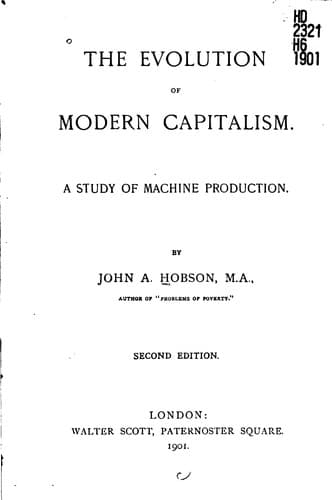
The Evolution of Modern Capitalism: A Study of Machine ProductionHobson, J. A. (John Atkinson)
History
The Evolution of Modern Capitalism: A Study of Machine Production
Hobson, J. A. (John Atkinson)
Capitalism; Industries -- History; Machinery in the workplace
§ 1. The theory of a "natural" rate of wages fixed at the bare
subsistence-point which was first clearly formulated in the writings
of Quesnay and the so-called "physiocratic" school was little more
than a rough generalisation of the facts of labour in France. But
these facts, summed up in the phrase, "Il ne gagne que sa vie," and
elevated to the position of a natural law, implied the general belief
that a higher rate of wage would not result in a correspondent
increase of the product of labour, that it would not pay an employer
to give wages above the point of bare sustenance and reproduction.
This dogma of the economy of cheap labour, taught in a slightly
modified form by many of the leading English economists of the first
half of the nineteenth century, has dominated the thought and
indirectly influenced the practice of the business world. It is true
that Adam Smith in a well-known passage had given powerful utterance
to a different view of the relation between work and wages:--"The
liberal reward of labour as it encourages the propagation so it
encourages the industry of the common people. The wages of labour are
the encouragement of industry, which, like every other human quality,
improves in proportion to the encouragement it receives."[225] But the
teaching of Ricardo, and the writers who most closely followed him in
his conception of the industrial system, leaned heavily in favour of
low wages as the sound basis of industrial progress.
The doctrine of the economy of low wages in England scarcely needed
the formal support of the scientific economist. It was already
strongly implanted in the mind of the eighteenth century "business
man," who moralised upon the excesses resulting from high wages much
in the tone of the business man of to-day. It would be scarcely
possible to parody the following line of reflection:--
"The poor in the manufacturing counties will never work any
more time in general than is necessary just to live and
support their weekly debauches. Upon the whole we may fairly
aver that a reduction of wages in the woollen manufactures
would be a national blessing and advantage and no real injury
to the poor. By this means we might keep our trade, uphold our
rents, and reform the people into the bargain." (Smith's
_Memoirs of Wool_, vol. ii. p. 308.)
Compare with this Arthur Young's frequent suggestion that rents should
be raised in order to improve farming.[226] So Dr. Ure, half a century
later, notwithstanding that his main argument is for the "economy of
high wages," both on the ground that it evokes the best quality of
work and because it keeps the workman contented, is unable to avoid
flatly contradicting himself as follows:--
Public-domain text, read in full here on John Shaqi.
Reviews
Reviews
No reviews yet
Be the first to share your thoughts on this work.
Elsewhere in the archive
Join the Discussion
Join the discussion
Sign in to leave a comment or review.
Sign InorCreate an account