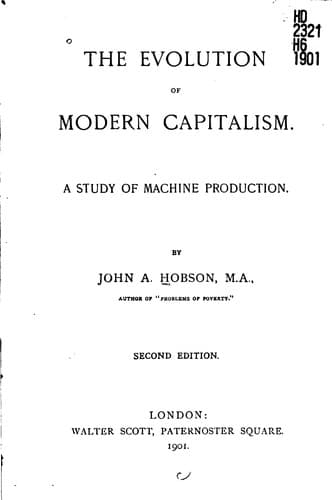
The Evolution of Modern Capitalism: A Study of Machine ProductionHobson, J. A. (John Atkinson)
History
The Evolution of Modern Capitalism: A Study of Machine Production
Hobson, J. A. (John Atkinson)
Capitalism; Industries -- History; Machinery in the workplace
§ 2. The trend of more recent thought has been in the direction of a
progressive modification of the doctrine of the "economy of low
wages." The common maxim that "if you want a thing well done you must
expect to pay for it" implies some general belief in a certain
correspondence of work and wages. The clearer formulation of this idea
has been in large measure the work of economic thinkers who have set
themselves to the close study of comparative statistics. The work in
which Mr. Brassey, the great railway contractor, was engaged gave him
an opportunity of making accurate comparison of the work and wages of
workmen of various nationalities, and his son, Sir Thomas Brassey,
collected and published a number of facts bearing upon the subject
which, as regards certain kinds of work, established a new relation
between work and wages. He found that English navvies employed upon
the Grand Trunk Railway in Canada, and receiving from 5s. to 6s. a
day, did a greater amount of work for the money than French-Canadians
paid at 3s. 6d. a day; that it was more profitable to employ
Englishmen at 3s. to 3s. 6d. upon making Irish railways than Irishmen
at 1s. 6d. to 1s. 8d.; that "in India, although the cost of dark
labour ranges from 4-1/2d. to 6d. a day, mile for mile the cost of
railway work is about the same as in England;" that in quarry work,
"in which Frenchmen, Irishmen, and Englishmen were employed side by
side, the Frenchman received three, the Irishman four, and the
Englishman six francs a day. At those different rates the Englishman
was found to be the most advantageous workman of the three." Extending
his inquiries to the building trades, to mining, and to various
departments of manufactures, he found a general consensus of opinion
among employers and other men of practical experience making for a
similar conclusion. In France, Germany, and Belgium, where wages and
the standard of living were considerably lower than in England, the
cost of turning out a given product was not less, but greater. In the
United States and in a few trades of Holland, where the standard of
comfort was as high or higher than in the corresponding English
industries, more or better work was done. In short, the efficiency of
labour was found to vary with tolerable accuracy in accordance with
the standard of comfort or real wages.
In his introduction to his work on _Foreign Work and English Wages_,
Sir Thomas Brassey gives countenance to a theory of wages which has
frequently been attributed to him, and has sometimes been accepted as
a final statement of the relation of work and wages--viz., that "the
cost of work, as distinguished from the daily wage of the labourer,
was approximately the same in all countries." In other words, it is
held that, for a given class of work, there is a fixed and uniform
relation between wages and efficiency of labour for different lands
and different races.
Public-domain text, read in full here on John Shaqi.
Reviews
Reviews
No reviews yet
Be the first to share your thoughts on this work.
Elsewhere in the archive
Join the Discussion
Join the discussion
Sign in to leave a comment or review.
Sign InorCreate an account