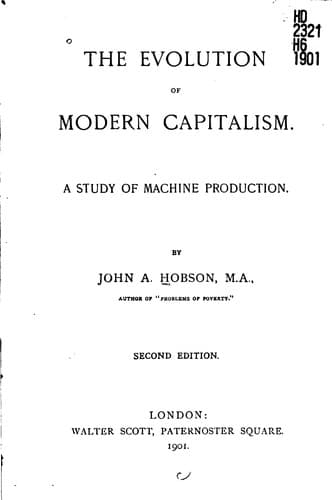
The Evolution of Modern Capitalism: A Study of Machine ProductionHobson, J. A. (John Atkinson)
History
The Evolution of Modern Capitalism: A Study of Machine Production
Hobson, J. A. (John Atkinson)
Capitalism; Industries -- History; Machinery in the workplace
Now, to the acceptance of this judgment, considered as a foundation of
a theory of comparative wages, there are certain obvious objections.
In the first place, in the statement of most of the cases which are
adduced to support the theory reference is made exclusively to money
wages, no account being taken of differences of purchasing power in
different countries. In order to establish any rational basis, the
relation must be between real wages or standard of living and
efficiency. Now, though it must be admitted as inherently probable
that some definite relation should subsist between wages and work, or,
in other words, between the standard of consumption and the standard
of production, it is not _à priori_ reasonable to expect this relation
should be uniform as between two such countries as England and India,
so that it should be a matter of economic indifference whether a piece
of work is done by cheap and relatively inefficient Indian labour or
by expensive and efficient English labour. Such a supposition could
only stand upon one of two assumptions.
The first assumption would be that of a direct arithmetical
progression in the relation of wage and work such as would require
every difference in quantity of food, etc., consumed by labourers to
be reflected in an exactly correspondent difference of output of
productive energy--an assumption which needs no refutation, for no one
would maintain that the standard of comfort furnished by wages is the
sole determinant of efficiency, and that race, climate, and social
environment play no part in economic production. The alternative
assumption would be that of an absolute fluidity of capital and
labour, which should reduce to a uniform level throughout the world
the net industrial advantages, so that everywhere there was an exact
quantitative relation between work and wage, production, and
consumption. Though what is called a "tendency" to such uniformity may
be admitted, no one acquainted with facts will be so rash as to
maintain that this uniformity is even approximately reached.
§ 3. There is, then, no reason to suppose that wages, either nominal
or real, bear any exact, or even a closely approximate, relation to
the output of efficient work, quantity and quality being both taken
into consideration. But, in truth, the evidence afforded by Sir T.
Brassey does not justify a serious investigation of this theory of
indifference or equivalence of work and wages. For, in the great
majority of instances which he adduces, the advantage is clearly shown
to rest with the labour which is most highly remunerated. The theory
suggested by his evidence is, in fact, a theory of "the economy of
high wages."
Public-domain text, read in full here on John Shaqi.
Reviews
Reviews
No reviews yet
Be the first to share your thoughts on this work.
Elsewhere in the archive
Join the Discussion
Join the discussion
Sign in to leave a comment or review.
Sign InorCreate an account