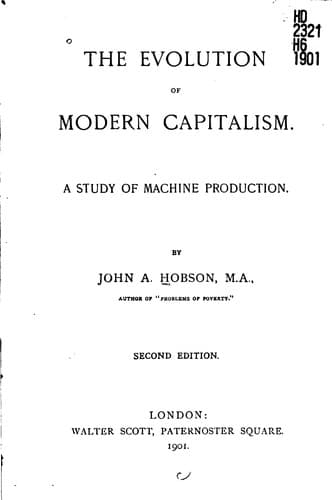
The Evolution of Modern Capitalism: A Study of Machine ProductionHobson, J. A. (John Atkinson)
History
The Evolution of Modern Capitalism: A Study of Machine Production
Hobson, J. A. (John Atkinson)
Capitalism; Industries -- History; Machinery in the workplace
This theory, which has been advancing by rapid strides in recent
years, and is now supported by a great quantity of carefully-collected
evidence, requires more serious consideration. The evidence of Sir T.
Brassey was chiefly, though by no means wholly, derived from branches
of industry where muscular strength was an important element, as in
road-making, railway-making, and mining; or from the building trades
where machinery does not play a chief part in directing the pace and
character of productive effort. It would not be unreasonable to expect
that the quantitative relation between work and wages might be closer
in industries where freely expended muscular labour played a more
prominent part than in industries where machinery was a dominating
factor, and where most of the work consisted in tending machinery. It
might well be the case that it would pay to provide a high standard of
physical consumption to navvies, but that it would not pay to the same
extent to give high wages to factory operatives, or even to other
classes of workers less subject to the strain of heavy muscular work.
In so far as the tendency of modern production is to relieve man more
and more of this rough muscular work, it might happen that the true
economy favoured high wages only in those kinds of work which were
tending to occupy a subordinate place in the industry of the future.
The earlier facts, which associated high wages with high productivity,
low wages with low productivity, in textile factories and ironworks,
were of a fragmentary character, and, considered as evidence of a
causal connection between high wages and high productivity, were
vitiated by the wide differences in the development of machinery and
industrial method in the cases compared. In recent years the labours
of many trained economists, some of them with close practical
knowledge of the industrial arts, have collected and tabulated a vast
amount of evidence upon the subject. A large number of American
economists, among them General F.A. Walker, Mr. Gunton, Mr. Schoenhof,
Mr. Gould, Mr. E. Atkinson, have made close researches into the
relation between work and wages in America and in the chief industrial
countries of Europe. A too patent advocacy of tariff reform or a
shorter working day has in some cases prevented the statistics
collected from receiving adequate attention, but there is no reason to
doubt the substantial accuracy of the research.
Public-domain text, read in full here on John Shaqi.
Reviews
Reviews
No reviews yet
Be the first to share your thoughts on this work.
Elsewhere in the archive
Join the Discussion
Join the discussion
Sign in to leave a comment or review.
Sign InorCreate an account