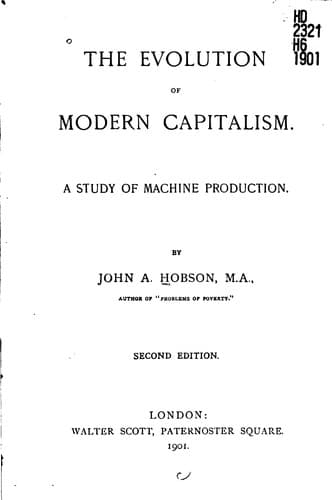
The Evolution of Modern Capitalism: A Study of Machine ProductionHobson, J. A. (John Atkinson)
History
The Evolution of Modern Capitalism: A Study of Machine Production
Hobson, J. A. (John Atkinson)
Capitalism; Industries -- History; Machinery in the workplace
All these factors must be taken into consideration before a full
judgment of the net results of machinery upon the worker can be
formed. The evidence above recorded, conclusive as it is regarding the
existence of some causal connection between a high standard of living
and high productivity of labour, does not necessarily justify the
conclusion that a business, or a federation of employers, may go ahead
increasing wages and shortening hours of labour _ad libitum_ in sure
and certain expectation of a corresponding increase in the net
productivity of labour.
Before such a conclusion is warranted, we must grasp more clearly the
nature of the causal relation between high standard of living and
efficiency. How far are we entitled to regard high wages and other
good conditions of employment as the cause, how far as the effect of
efficiency of labour? The evidence adduced simply proves that _a_ _b_
_c_, certain phenomena relating to efficiency--as size of product,
speed of workmanship, quantity of machines tended--vary directly with
_d_ _e_ _f_, certain other phenomena relating to wages, hours of
labour, and other conditions of employment. So far as such evidence
goes, we are only able to assert that the two sets of phenomena are
causally related, and cannot surely determine whether variations in
_a_ _b_ _c_ are causes, or effects of concomitant variations in _d_
_e_ _f_, or whether both sets of phenomena are or are not governed by
some third set, the variations of which affect simultaneously and
proportionately the other two.
The moral which writers like Mr. Gunton and Mr. Schoenhof have sought
to extract, and which has been accepted by not a few leaders in the
"labour movement," is that every rise of wages and every shortening of
hours will necessarily be followed by an equivalent or a more than
equivalent rise in the efficiency of labour. In seeking to establish
this position, special stress is laid upon the evidence of the
comparative statistics of textile industries. But, in the first place,
it must be pointed out that the evidence adduced does not support any
such sweeping generalisation. The statistics of Mr. Gould and Mr.
Schoenhof, for instance, show many cases where higher money and real
wages of American operatives are not accompanied by a correspondingly
larger productivity. In such cases the "cheap" labour of England is
really cheap.
Public-domain text, read in full here on John Shaqi.
Reviews
Reviews
No reviews yet
Be the first to share your thoughts on this work.
Elsewhere in the archive
Join the Discussion
Join the discussion
Sign in to leave a comment or review.
Sign InorCreate an account