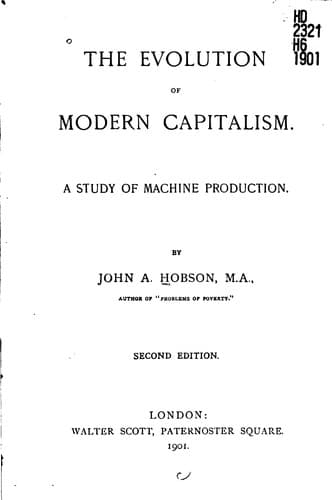
The Evolution of Modern Capitalism: A Study of Machine ProductionHobson, J. A. (John Atkinson)
History
The Evolution of Modern Capitalism: A Study of Machine Production
Hobson, J. A. (John Atkinson)
Capitalism; Industries -- History; Machinery in the workplace
Again, in other cases where the higher wages of American workers are
accompanied by an equivalent, or more than equivalent, increase of
product, that increased product is not due entirely or chiefly to
greater intensity or efficiency of labour, but to the use of more
highly elaborated labour-saving machinery. The difference between the
labour-cost of making and maintaining this improved machinery, and
that of making and maintaining the inferior machinery it has
displaced, ought clearly to be added in, where a comparison is made
between the relation of net labour-cost to product in different
countries, or in different stages of industrial development in the
same country. The omission of this invalidates much of the reasoning
of Schulze-Gaevernitz, Brentano, Rae, and other prophets of "the
economy of high wages." The direct labour-cost of each commodity may
be as little, or even less, than in England, but the total cost of
production[231] and the selling price may be higher. Lastly, in that
comparison between England and America, which is in many respects the
most serviceable, because the two countries are nearest in their
development of industrial methods as well as in the character of their
labourers, the difference of money and of real wage is not commonly
accompanied by a difference in hours of labour.
The evidence we possess does not warrant any universal or even general
application of the theory of the economy of high wages. If it was
generally true that by increasing wages and by shortening working
hours the daily product of each labourer could be increased or even
maintained, the social problem, so far as it relates to the
alleviation of the poverty and misery of the lower grades of workers,
would admit of an easy solution. But though it will be generally
admitted that a rise of wages or of the general standard of comfort of
most classes of workers will be followed by increased efficiency of
labour, and that a shortening of hours will not be followed by a
corresponding diminution in output, it by no means follows that it
will be profitable to increase wages and shorten hours indefinitely.
Just as it is admitted that the result of an equal shortening of hours
will be different in every trade, so will the result of a given rise
in standard of comfort be different. In some cases highly-paid labour
and short hours will pay, in other cases cheaper labour and longer
hours. It is not possible by dwelling upon the concomitance of high
wages and good work, low wages and bad work, in many of the most
highly-developed industries to appeal to the enlightened self-interest
of employers for the adoption of a general rise in wages and a general
shortening of hours. Because the most profitable business may often be
conducted on a system which involves high wages for short intense work
with highly evolved machinery, it by no means follows that other
businesses may not be more profitably conducted by employing low-paid
Public-domain text, read in full here on John Shaqi.
Reviews
Reviews
No reviews yet
Be the first to share your thoughts on this work.
Elsewhere in the archive
Join the Discussion
Join the discussion
Sign in to leave a comment or review.
Sign InorCreate an account