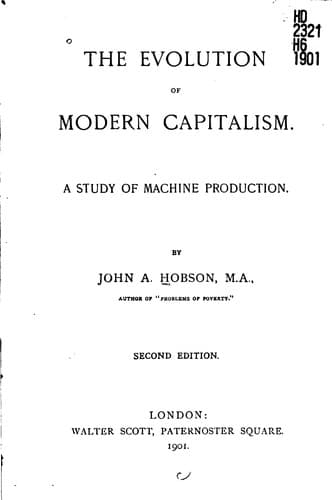
The Evolution of Modern Capitalism: A Study of Machine ProductionHobson, J. A. (John Atkinson)
History
The Evolution of Modern Capitalism: A Study of Machine Production
Hobson, J. A. (John Atkinson)
Capitalism; Industries -- History; Machinery in the workplace
In cotton-weaving in America it pays better to employ women at high
wages to tend six, seven, or even eight looms for short hours, than to
pay lower wages to inferior workers such as are found in Germany,
Switzerland, or even in Lancashire. But in coal-mining it appears that
the American wages are economically too high--that is to say, the
difference between American and English wages is not compensated by an
equivalent difference of output. The gross number of tons mined by
United States miners working at wages of $326 per annum is 377,
yielding a cost of 86-1/2 cents per ton, as compared with 79 cents per
ton, the cost of North Staffordshire coal produced by miners earning
$253, and turning out 322 tons per head.[233] So also a ton of
Bessemer pig iron costs in labour about 50 cents more in America than
in England, the American wages being about 40 per cent. higher.[234]
It is, indeed, evident from the aggregate of evidence that no
determinable relation exists between cost in labour and wages for any
single group of commodities.
Just as little can a general acceptance be given to the opposite
contention that it is the increased efficiency of labour which causes
the high wages. This is commonly the view of those business men and
those economists who start from the assumption that there is some law
of competition in accordance with whose operation every worker
necessarily receives as much as he is worth, the full value of the
product of his labour. Only by the increased efficiency of labour can
wages rise, argue these people; where wages are high the efficiency of
labour is found to be high, and _vice versâ_; therefore efficiency
determines wages. Just as the advocates of the economy of high-wages
theory seek by means of trade-unionism, legislation, and public
opinion to raise wages and shorten hours, trusting that the increased
efficiency which ensues will justify such conduct, so the others
insist that technical education and an elevation of the moral and
industrial character of the workers must precede and justify any rise
of wages or shortening of hours, by increasing the efficiency of
labour. Setting aside the assumption here involved that the share of
the workers in the joint product of capital and labour is a fixed and
immovable proportion, this view rests upon a mere denial of the effect
which it is alleged that high wages and a rise in standard of comfort
have in increasing efficiency.
The relation between wages and other conditions of employment, on the
one hand, and efficiency of labour or size of product on the other, is
clearly one of mutual determination. Every rise in wages, leisure, and
in general standard of comfort will increase the efficiency of labour;
every increased efficiency, whether due directly to these or to other
causes, will enable higher wages to be paid and shorter hours to be
worked.
Public-domain text, read in full here on John Shaqi.
Reviews
Reviews
No reviews yet
Be the first to share your thoughts on this work.
Elsewhere in the archive
Join the Discussion
Join the discussion
Sign in to leave a comment or review.
Sign InorCreate an account