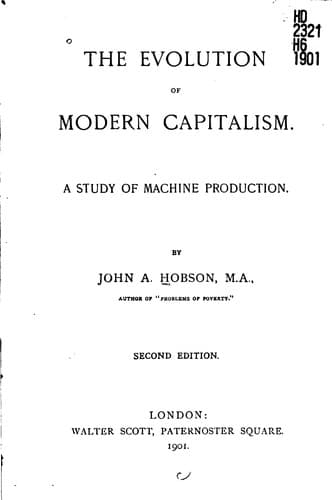
The Evolution of Modern Capitalism: A Study of Machine ProductionHobson, J. A. (John Atkinson)
History
The Evolution of Modern Capitalism: A Study of Machine Production
Hobson, J. A. (John Atkinson)
Capitalism; Industries -- History; Machinery in the workplace
§ 6. One further point emerges from the evidence relating to
efficiency and high wages. According to Schulze-Gaevernitz's formula,
every fall in piece wages is attended by a rise in weekly wages. But
it should be kept in mind that a rise in time wages does not
necessarily mean that the price of labour measured in terms of effort
has been raised. Intenser labour undergone for a shorter time may
obtain a higher money wage per unit of time, but the price per unit of
effort may be lower. It has been recognised that a general tendency of
the later evolution of machinery has been to compress and intensify
labour. In certain classes of textile labour the amount of muscular or
manual labour given out in a day is larger than formerly. This is the
case with the work of children employed as piecers. In Ure's day
(1830) he was able to claim that during three-fourths of the time
spent by children in the factory they had nothing to do. The increased
quantity of spindles and the increased speed have made their labour
more continuous. The same is true of the mule spinners, whose labour,
even within the last few years, has been intensified by increased size
of the mule. Though as a rule machinery tends to take over the heavier
forms of muscular work, it also tends to multiply the minor calls upon
the muscles, until the total strain is not much less than before. What
relief is obtained from muscular effort is compensated by a growing
strain upon the nerves and upon the attention. Moreover, as the
machinery grows more complex, numerous, and costly, the responsibility
of the machine-tender is increased. To some considerable extent the
new effort imposed upon the worker is of a more refined order than the
heavy muscular work it has replaced. But its tax upon the physique is
an ever-growing one. "A hand-loom weaver can work thirteen hours a
day, but to get a six-loom weaver to work thirteen hours is a physical
impossibility."[235] The complexity of modern machinery and the
superhuman celerity of which it is capable suggest continually an
increased compression of human labour, an increased output of effort
per unit of time. This has been rendered possible by acquired skill
and improved physique ensuing on a higher standard of living. But it
is evident that, where it appears that each rise in the standard of
living and each shortening of the working-day has been accompanied by
a severer strain either upon muscles, nerves, or mental energy during
the shorter working day, we are not entitled to regard the higher
wages and shorter hours as clear gain for the worker. Some limits are
necessarily imposed upon this compressibility of working effort. It
would clearly be impossible by a number of rapid reductions of the
working day and increases of time wages to force the effectiveness of
an hour's labour beyond a certain limit for the workers. Human nature
must place limits upon the compression. Though it may be better for a
Public-domain text, read in full here on John Shaqi.
Reviews
Reviews
No reviews yet
Be the first to share your thoughts on this work.
Elsewhere in the archive
Join the Discussion
Join the discussion
Sign in to leave a comment or review.
Sign InorCreate an account