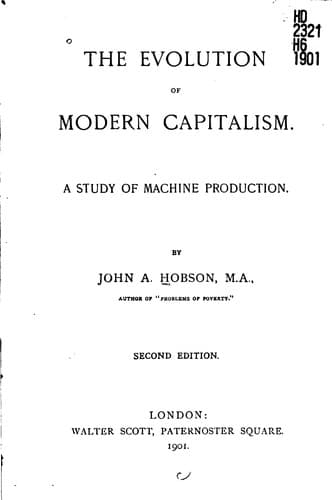
The Evolution of Modern Capitalism: A Study of Machine ProductionHobson, J. A. (John Atkinson)
History
The Evolution of Modern Capitalism: A Study of Machine Production
Hobson, J. A. (John Atkinson)
Capitalism; Industries -- History; Machinery in the workplace
The importance of this point is frequently ignored alike by advocates
of a shorter working-day and by those who insist that the chief aim of
workers should be to make their labour more productive. So far as the
higher efficiency simply means more skill and involves no increased
effort it is pure gain, but where increased effort is required the
question is one requiring close and detailed consideration.
§ 7. Another effect of over-compressed labour deserves a word.
The close relation between higher wages and shorter hours is generally
acknowledged. A rise of money wages which affects the standard of
living by introducing such changes in consumption as require for their
full yield of benefit or satisfaction an increase of consuming-time
can only be made effective by a diminution in the producing time or
hours of labour. When, for example, the new wants, whose satisfaction
would be naturally sought from a rise of the standard living, are of
an intellectual order, involving not merely the purchase of books,
etc., but the time to read such books, this benefit requires that the
higher wages should be supplemented by a diminution in the hours of
labour in cases where the latter are unduly long. But it is not so
clearly recognised that such questions cannot be determined without
reference to the question of intensity of labour. Yet it is evident
that an eight-hours day of more compressed labour might be of a more
exhausting character than a ten-hours day of less intense labour and
disqualify a worker from receiving the benefits of the opportunities
of education open to him more than the longer hours of less intense
labour. The advantage of the addition of two hours of leisure might be
outweighed by the diminished value attached to each leisure hour. In
other words, the excess of intense work might be worse in its effects
than the excess of more extended work. This possibility is often
overlooked in the arguments of those who support the movement towards
a shorter working-day by maintaining that each unit of labour-time
will be more productive. When the argument concerns itself merely with
alleging the influence of higher wages, without shorter hours, upon
the efficiency of labour, this neglect of the consideration of intense
labour has a more urgent importance. It may be gravely doubted whether
the benefit of the higher wages of the Massachusetts weavers is not
overbalanced by the increased effort of tending so large a number of
looms for hours which are longer than the English factory day. The
exhausting character of such labour is likely to leave its mark in
diminishing the real utility or satisfaction of the nominally higher
standard of living which the high wages render possible. Where the
increased productivity of labour is largely due to the improved
machinery or methods of production which are stimulated by high wages
without a corresponding intensification of the labour itself, the gain
to labour is clear.
Public-domain text, read in full here on John Shaqi.
Reviews
Reviews
No reviews yet
Be the first to share your thoughts on this work.
Elsewhere in the archive
Join the Discussion
Join the discussion
Sign in to leave a comment or review.
Sign InorCreate an account