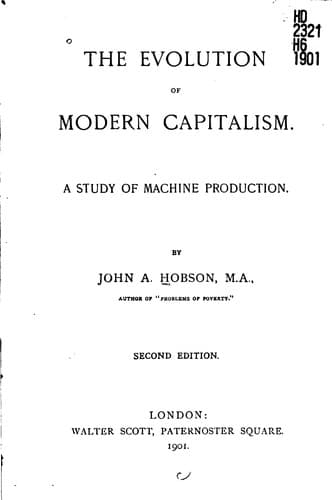
The Evolution of Modern Capitalism: A Study of Machine ProductionHobson, J. A. (John Atkinson)
History
The Evolution of Modern Capitalism: A Study of Machine Production
Hobson, J. A. (John Atkinson)
Capitalism; Industries -- History; Machinery in the workplace
weaver to tend four looms during the English factory day for the
moderate wage of 16s. a week than to earn 11s. 8d. by tending two
looms in Germany for twelve hours a day, it does not follow that it is
better to earn 20s. 3d. in America by tending six, seven, or even
eight looms for a ten-hours day,[236] or that the American's condition
would be improved if the eight-hours day was purchased at the expense
of adding another loom for each worker.
The gain which accrues from high wages and a larger amount of leisure,
over which the higher consumption shall be spread, may be more than
counteracted by an undue strain upon the nerves or muscles during the
shorter day. This difficulty, as we have seen, is not adequately met
by assigning the heavier muscular work more and more to machinery, if
the possible activity of this same machinery is made a pretext for
forcing the pace of such work as devolves upon machine-tenders.
In many kinds of work, though by no means in all, an increase of the
amount of work packed into an hour could be obtained by a reduction of
the working-day; but two considerations should act in determining the
progressive movement in this direction: first, the objective economic
question of the quantitative relation between the successive
decrements of the working-day and the increments of labour put into
each hour; second, the subjective economic question of the effect of
the more compressed labour upon the worker considered both as worker
and as consumer.
There is not wanting evidence to show that increased leisure and
higher wages can be bought too dear.
In drawing attention to this consideration it must not, however, be
assumed that the increase of real wages and shortening of hours traced
in progressive industries are necessarily accompanied by a
corresponding increase in the compression of labour. In the textile
and iron industries, for example, it is evident (_pace_ Karl Marx)
that the operatives had obtained some portion of the increased
productivity of improved machinery in a rise of wages. Even where more
machinery is tended we are not entitled to assume a correspondent
increase in felt effort or strain upon the worker. A real growth of
skill or efficiency will enable an increased amount of machinery to be
tended with no greater subjective effort than a smaller amount
formerly required. But while allowance should be made for this, the
history of the factory system, both in England and in other countries,
clearly indicates that factory labour is more intense than formerly,
not, perhaps, in its tax upon the muscles, but in the growing strain
it imposes upon the nervous system of the operatives.
Public-domain text, read in full here on John Shaqi.
Reviews
Reviews
No reviews yet
Be the first to share your thoughts on this work.
Elsewhere in the archive
Join the Discussion
Join the discussion
Sign in to leave a comment or review.
Sign InorCreate an account