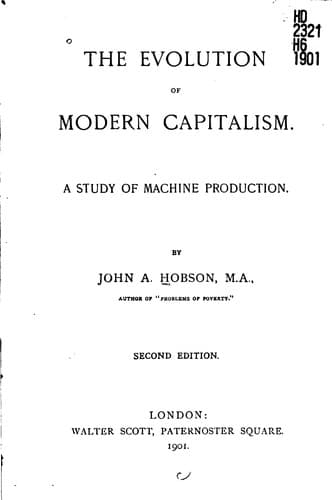
The Evolution of Modern Capitalism: A Study of Machine ProductionHobson, J. A. (John Atkinson)
History
The Evolution of Modern Capitalism: A Study of Machine Production
Hobson, J. A. (John Atkinson)
Capitalism; Industries -- History; Machinery in the workplace
labour as to stimulate a series of such rises. The automatic movement
which Schulze-Gaevernitz and others trace in the typical
machine-industries is not shown to apply to industry as a whole, and
if the tendency of machine-development is to absorb a larger
proportion of the work but a smaller proportion of the workers, it is
not possible to found large hopes for the future of the working
classes upon this movement of the earning of high wages in
machine-industry.
§ 9. But though the individual self-interest of the producer cannot be
relied upon to favour progressive wages, except in certain industries
and up to a certain point, the collective interest of consumers lends
stronger support to "the economy of high wages." We have seen that the
possession of an excessive proportion of "power to consume" by classes
who, because their normal healthy wants are already fully satisfied,
refuse to exert this power, and insist upon storing it in unneeded
forms of capital, is directly responsible for the slack employment of
capital and labour. If the operation of industrial forces throw an
increased proportion of the "power to consume" into the hands of the
working classes, who will use it not to postpone consumption but to
raise their standard of material and intellectual comfort, a fuller
and more regular employment of labour and capital must follow. If the
stronger organisation of labour is able to raise wages, and the higher
wages are used to demand more and better articles of consumption, a
direct stimulus to the efficiency of capital and labour is thus
applied. The true issue, however, must not be shirked. If the power of
purchase now "saved" by the wealthier classes passed into the hands of
the workers in higher money wages, and was not spent by them in
raising their standard of comfort, but was "invested" in various
forms of capital, no stimulus to industry would be afforded; the
"savings" of one class would have fallen into the hands of another
class, and their excess would operate to restrict industry precisely
as it now operates. Though we would gladly see in the possession of
the working classes an increased proportion of those forms of capital
which are socially useful, this simple act of transfer, however
brought about, would furnish no stimulus to the aggregate industry.
From the standpoint of the community nothing else than a rise in the
average standard of current consumption can stimulate industry. When
it is clearly grasped that a demand for commodities is the only demand
for the use of labour and of capital, and not merely determines in
what particular direction these requisites of production shall be
applied, the hope of the future of our industry is seen to rest
largely upon the confident belief that the working classes will use
their higher wages not to draw interest from investments (a
self-destructive policy) but to raise their standard of life by the
current satisfaction of all those wholesome desires of body and mind
Public-domain text, read in full here on John Shaqi.
Reviews
Reviews
No reviews yet
Be the first to share your thoughts on this work.
Elsewhere in the archive
Join the Discussion
Join the discussion
Sign in to leave a comment or review.
Sign InorCreate an account