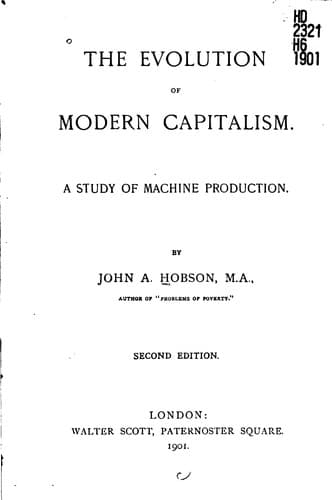
The Evolution of Modern Capitalism: A Study of Machine ProductionHobson, J. A. (John Atkinson)
History
The Evolution of Modern Capitalism: A Study of Machine Production
Hobson, J. A. (John Atkinson)
Capitalism; Industries -- History; Machinery in the workplace
which lie latent under an "economy of low wages." The satisfaction of
new good human desires, by endowing life with more hope and interest,
will render all intelligent exertion more effective, by distributing
demand over a larger variety of commodities will give a fuller
utilisation both of natural and human resources, and by redressing the
dislocated balance of production and consumption due to inequality of
purchasing power, will justify high wages by increased fulness and
regularity of work. But it must be clearly recognised that however
desirable "saving" may seem to be as a moral virtue of the working
classes, any large practice of saving undertaken before and in
preference to an elevation of current consumption, will necessarily
cancel the economic advantages just dwelt upon. Just as the wise
individual will see he cannot afford to "save" until he has made full
provision for the maintenance of his family in full physical
efficiency, so the wise working class will insist upon utilising
earlier accesses of wages in promoting the physical and intellectual
efficiency of themselves and their families before they endeavour to
"invest" any considerable portion of their increased wages. Mr. Gould
puts this point very plainly and convincingly: "Where economic gains
are small, savings mean a relatively low plane of social existence. A
parsimonious people are never progressive, neither are they, as a
rule, industrially efficient. It is the man with many wants--not
luxurious fancies, but real legitimate wants--who works hard to
satisfy his aspirations, and he it is who is worth hiring. Let
economists still teach the utility and the necessity of saving, but
let the sociologist as firmly insist that to so far practise economy
as to prevent in the nineteenth century a corresponding advance in
civilisation of the working with the other classes is morally
inequitable and industrially bad policy. I am not sorry that the
American does not save more. Neither am I sure but that if many
working-class communities I have visited on the Continent were
socially more ambitious, there would not be less danger from Radical
theories. One of the most intelligent manufacturers I ever met told me
a few years ago he would be only too glad to pay higher wages to his
working people, provided they would spend the excess legitimately and
not hoard it. He knew that in the end he should gain thereby, since
the ministering to new wants only begets others."[237] If there are
theoretic economists who still hold that "a demand for commodities is
not a demand for labour," they may be reminded that a paradox is not
necessarily true. In fact, this particular paradox is seen to be
sustained by a combination of slipshod reasoning and moral prejudice.
The growing opinion of economic students is veering round to register
in theory the firm empirical judgment from which the business world
has never swerved, that a high rate of consumption is the surest
guarantee of progressive trade.
Public-domain text, read in full here on John Shaqi.
Reviews
Reviews
No reviews yet
Be the first to share your thoughts on this work.
Elsewhere in the archive
Join the Discussion
Join the discussion
Sign in to leave a comment or review.
Sign InorCreate an account