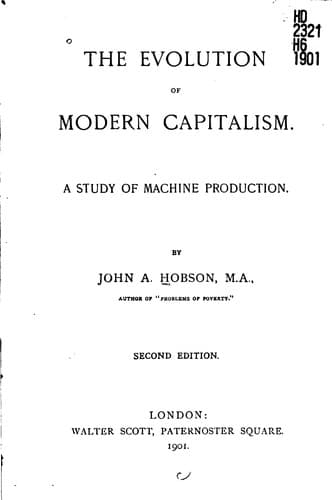
The Evolution of Modern Capitalism: A Study of Machine Production — John Shaqi
The Evolution of Modern Capitalism: A Study of Machine ProductionHobson, J. A. (John Atkinson)
History
The Evolution of Modern Capitalism: A Study of Machine Production
Hobson, J. A. (John Atkinson)
Capitalism; Industries -- History; Machinery in the workplace
Next to the woollen, but far behind in size and importance, came the
iron trade. In 1720 England seems to have developed her mining
resources so imperfectly as to be in the condition of importing from
foreign countries 20,000 out of the 30,000 tons required for her
hardware manufactures.[17] Almost all this iron was destined to home
consumption with the exception of hardware forced upon the American
colonies, who were forbidden to manufacture for themselves. In 1720 it
is calculated that mining and manufacture of iron and hardware
employed 200,000 persons.[18]
Copper and brass manufactures employed some 30,000 persons in
1720.[19]
Silk was the only other highly developed and considerable
manufacture. It had, however, to contend with Indian competition,
introduced by the East India Company, and also with imported
calicoes.[20] In 1750 there were about 13,000 looms in England, the
product of which was almost entirely used for home consumption. Cotton
and linen were very small manufactures during the first half of the
eighteenth century. At the beginning of the century the linen trade
was chiefly in the hands of Russia and Germany, although it had taken
root in Ireland as early as the close of the seventeenth century, and
was worked to some extent in Lancashire, Leicestershire, and round
Darlington in Yorkshire, which districts supplied the linen-warp to
the cotton weavers.[21] As for cotton, even in 1760 not more than
40,000 persons were engaged in the manufacture, and in 1764 the cotton
exports were but one-twentieth of the value of the woollen
exports.[22] The small value of the cotton trade and an anticipatory
glance at its portentous after-growth is conveyed in the following
figures:--
Home Market. Export Trade.
1766 £379,241 £220,759 (Postletwayte)
1819-21 13,044,000 15,740,000 }
1829-31 13,351,000 18,074,000 } (Ellison[23])
The many other little manufactures which had sprung up, such as glass,
paper, tin-plate, produced entirely for home consumption, and employed
but a small number of workers.
§ 6. If we turn from the consideration of the size of English industry
and the several departments to the analysis of its structure and the
relation to the several trades, we shall find the same signs of
imperfect organic development which we found in the world-industry,
though not so strongly marked. Just as we found each country in the
main self-sufficing, so we find each district of England (with a few
significant exceptions) engaged chiefly in producing for its own
consumption. There was far less local specialisation in industry than
we find to-day. The staple industries, tillage, stock-raising, and
those connected with the supply of the common articles of clothing,
furniture, fuel, and other necessaries were widespread over the whole
country.
Public-domain text, read in full here on John Shaqi.
Reviews
Reviews
No reviews yet
Be the first to share your thoughts on this work.
Join the Discussion
Join the discussion
Sign in to leave a comment or review.
Sign InorCreate an account