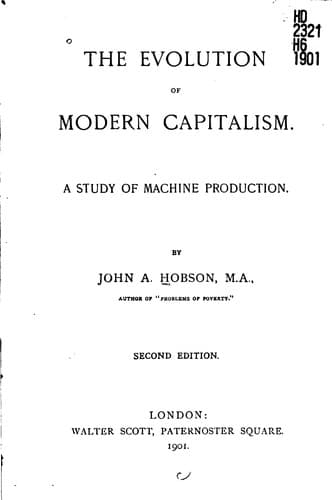
The Evolution of Modern Capitalism: A Study of Machine ProductionHobson, J. A. (John Atkinson)
History
The Evolution of Modern Capitalism: A Study of Machine Production
Hobson, J. A. (John Atkinson)
Capitalism; Industries -- History; Machinery in the workplace
When we turn to the textile industries and to dress, the change of
proportionate employment among the sexes is very noteworthy. In
textiles and dyeing there was a continuous decline in the absolute
numbers of adult male workers and a continuous increase of female
workers up to 1881. In 1851 there were 394,400 men employed, in 1881
the number had fallen to 345,900, while the women had risen during the
same period from 390,800 to 500,200. The census figures for 1891 mark
a decided check in this movement. Adult male workers show an increase
of 34,000 upon the 1881 figures in the textile industries, while the
increase of female workers is only 15,000. This is due, on the one
hand, to the feverish and disordered expansion of the cotton
industry, which offers a larger proportion of male employment than
other textile branches; on the other hand, to the alarming decay of
the lace and linen industries, which show an absolute decline of
female employment amounting to nearly 13,000. So likewise in the dress
industries 377,400 men were employed in 1851, and 335,900 in 1881,
while the number of women employed had increased from 441,000 to
589,000.[240]
[Illustration]
These figures chiefly indicate a displacement of male by female
labour. But the movement is by no means peculiar to the textile and
dress industries which may appear specially adapted to the faculties
of women. Wherever women have got a firm footing in a manufacture a
similar movement is traceable; the relative rate of increase in the
employment of women exceeds that of men, even where the numbers of the
latter do not show an absolute decline. Such industries are wood
furniture and carriages; printing and bookbinding; paper, floorcloths,
waterproof; feathers, leather, glues; food, drink, smoking;
earthenware, machinery, tools.[241] Women have also obtained
employment in connection with other industries which are still in the
main "male" industries, and in which no women, or very few, were
engaged in 1841. Such are fuel, gas, chemicals; watches, instruments,
toys. The only group of machine industries in which their numbers have
not increased more rapidly than those of men since 1851 are the metal
industries. Over some of these, however, they are obtaining an
increased hold. In the "more mechanical portions" of the growing
"cycle" industry, hollow-ware, and in certain departments of the
watchmaking trade, they are ousting male labour, executing with
machinery the work formerly done by male hand-workers.[242]
From this and similar evidence relating to the statistics of
employment in modern industrial countries, the following conclusions
seem justified:--
(1.) That the tendency of modern industry is to increase the quantity
of wage-work given to women as compared with that given to men.
Public-domain text, read in full here on John Shaqi.
Reviews
Reviews
No reviews yet
Be the first to share your thoughts on this work.
Elsewhere in the archive
Join the Discussion
Join the discussion
Sign in to leave a comment or review.
Sign InorCreate an account