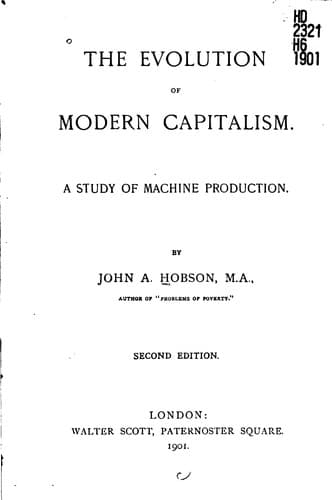
The Evolution of Modern Capitalism: A Study of Machine ProductionHobson, J. A. (John Atkinson)
History
The Evolution of Modern Capitalism: A Study of Machine Production
Hobson, J. A. (John Atkinson)
Capitalism; Industries -- History; Machinery in the workplace
In qualification of this tendency consideration should be taken of the
greater irregularity of women's work, and of the fact that a large
number of women returned as industrial workers give only a portion of
their working-day to industry.
(2.) That this tendency is specially operative in manufacturing
industries. The increase of female employment in the "dealing"
industries and in "industrial service" is not larger than the increase
of male employment between 1851 and 1881.
(3.) That in the manufacturing industries, omitting a few essentially
male industries where even under machinery the muscles are severely
taxed, the increased rate of female employment is greatest in those
industries where machinery has been most highly developed, as for
example in the textile industries and dress.
Out of 1,840,898 women placed in the industrial class in 1891 no fewer
than 1,319,441 were engaged in textile industries and dress, though
under the latter head there is of course still a good deal of hand
industry.
It seems evident that modern improvements in machinery under normal
circumstances favour the employment of women rather than of men. There
is some reason to suppose that machinery also favours the employment
of children as compared with adults, where the economic forces are
allowed free play. In the textile industries of the United States the
work of women and children predominates even more largely than in
England; in 1880 the number of women and children employed were
112,859 as compared with 59,685 men, while in Massachusetts out of
61,246 work-people only 22,180 were adult males. So far as legislation
and public opinion do not interfere, the tendency is strongly in
favour of employing children. Mr. Wade says, in _Fibre and Fabric_,
"The tendency of late years is towards the employment of child labour.
We see men frequently thrown out of employment owing to the spinning
mule being displaced by the ring-frame, or children spinning yarn
which men used to spin. In the weave-shops, girls and women are
preferable to men, so that we may reasonably expect that in the not
very distant future all the cotton manufacturing districts will be
classed in the category of she-towns."[243]
Public-domain text, read in full here on John Shaqi.
Reviews
Reviews
No reviews yet
Be the first to share your thoughts on this work.
Elsewhere in the archive
Join the Discussion
Join the discussion
Sign in to leave a comment or review.
Sign InorCreate an account