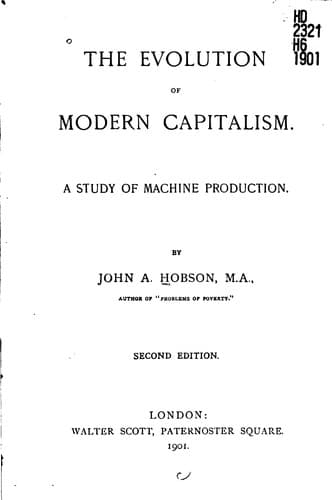
The Evolution of Modern Capitalism: A Study of Machine ProductionHobson, J. A. (John Atkinson)
History
The Evolution of Modern Capitalism: A Study of Machine Production
Hobson, J. A. (John Atkinson)
Capitalism; Industries -- History; Machinery in the workplace
So far as children are concerned, the economic tendency to adjust
machine-tending to their limited strength is in some measure defeated
by the growth of strong public feeling and legislative protection of
younger children. Had full and continued licence been allowed to the
purely "economic" tendencies of the factory system in this country and
in America, there can be little doubt but that almost the whole of the
textile industry and many other large departments of manufacture would
be administered by the cheap labour of women and young children. The
profits attending this free exploitation of cheap labour would have
been so great that invention would have been concentrated, even more
than has been the case, upon spreading out the muscular exertion and
narrowing the technical skill so as to suit the character of the
cheaper labour. It is quite possible that some of the oppressive
conditions of our early factory system, the exhausting hours of
labour, the cruelty of overseers, the utter neglect of all sanitation,
the bad food, might have been found opposed to the true interests of
economy and efficiency, and that the more developed factory might have
been managed more humanely. But if we may judge by the progress made
in the employment of weaker labour where it has had free scope, it
seems reasonable to believe that, had no Factory Acts been passed, and
had public feeling furnished no opposition, the great mass of the
textile factories of this country would have been almost entirely
worked by women and children.
We have seen already that the advantages attending efficient labour
furnish no guarantee that it will be most profitable to employ the
most efficient labour at the highest wages. The evidence of industrial
history shows that it will often be most profitable to employ less
efficient labour provided that labour can be got "cheap." The
increasing employment of women in machine-industry is in nearly all
cases directly traceable to the "cheapness" of woman's labour as
compared with man's.
§ 3. Thus we are brought to the discussion of the important question
which underlies all understanding of the position of woman in modern
industry--"Why are women paid less wages than men?"
Public-domain text, read in full here on John Shaqi.
Reviews
Reviews
No reviews yet
Be the first to share your thoughts on this work.
Elsewhere in the archive
Join the Discussion
Join the discussion
Sign in to leave a comment or review.
Sign InorCreate an account