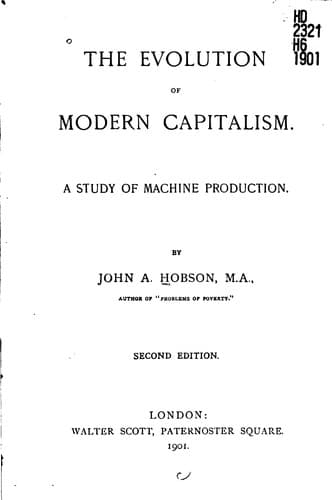
The Evolution of Modern Capitalism: A Study of Machine ProductionHobson, J. A. (John Atkinson)
History
The Evolution of Modern Capitalism: A Study of Machine Production
Hobson, J. A. (John Atkinson)
Capitalism; Industries -- History; Machinery in the workplace
§ 2. In modern machinery a larger and larger amount of inventive skill
is engaged in adjusting machine-tending to the physical and mental
capacity of women and children. The evolution of machinery has not
moved constantly in this direction. In cotton-spinning, for example,
the earlier machines--Hargreave's jennies and Arkwright's
water-frames--were generally worked by women and children, the women
who had been engaged in the use of the older instruments--the distaff,
spindle, hand-wheel--coming into the mills. But the growing complexity
and size of the mule made it too cumbrous for women and children, and
spinning for a while became a male occupation in England. In the
United States the difficulty of procuring male labour stimulated the
invention of the ring spinning-frame, some sixty years ago, which
could be worked by woman's labour. The limitations and imperfections
of this mode of spinning retarded its adoption in England for upwards
of half a century. But recent improvements have led to a rapid
increase of the adoption of the ring-frame in Lancashire. In the low
medium and low counts it is rapidly displacing the mule, and in
countries where fine counts are little spun it will probably be the
dominant machine.[244] In Lancashire it does not, however, seem at all
likely to be rendered capable of displacing the mule in finer counts.
The ring-frame throws spinning once more into the hands of women and
of children, who in some Lancashire towns are quickly displacing the
labour of the men.
Public-domain text, read in full here on John Shaqi.
Reviews
Reviews
No reviews yet
Be the first to share your thoughts on this work.
Elsewhere in the archive
Join the Discussion
Join the discussion
Sign in to leave a comment or review.
Sign InorCreate an account