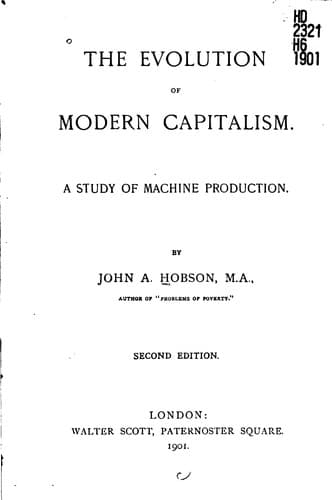
The Evolution of Modern Capitalism: A Study of Machine ProductionHobson, J. A. (John Atkinson)
History
The Evolution of Modern Capitalism: A Study of Machine Production
Hobson, J. A. (John Atkinson)
Capitalism; Industries -- History; Machinery in the workplace
(4) This inferior efficiency is not solely attributable to these
reasons. Woman's incentive to acquire industrial efficiency is not so
great as man's. A large number of women-workers do not enter an
industrial occupation as the chief means of support throughout their
life. The influence of matrimony and domestic life operates in various
ways upon women's industry. The expectation of marriage and a release
from industrial work must lessen the interest of women in their work.
The fact that even while unmarried a large proportion of women-workers
are not dependent upon their earnings for a livelihood will have the
same result. A larger proportion of the woman's industrial career is
occupied in acquiring the experience which makes her a valuable
worker, and the probability that, after she has acquired it, she may
not need to use it, diminishes both directly and indirectly the net
value of her industrial life; the element of uncertainty and
instability prevents the advancement of competent women to posts where
fixity of tenure is an important factor.
Where married women are engaged in industrial work either in factories
or at home, domestic work of necessity engages some of their strength
and interest, and is liable to trench upon the energy which otherwise
might go into industry. Even unmarried women have frequently some
domestic work to do which is added to their industrial work. Thus the
incentive to efficiency is weaker in woman, her industrial position is
less stable and her industrial life shorter, while part of her energy
is diverted to other than industrial channels.
(5) There is conclusive evidence to show that women are more often
absent from work owing to sickness and other claims upon their time
than men.[250] Though closely related to the former factors this may
be treated separately in assessing the net productiveness of women,
because it is distinctly measurable. But in touching this point it
should be remarked that weaker muscular development does not
necessarily imply more sickness. The loss of working time sustained by
women could probably be reduced considerably by more attention to
physical training and exercise and by a higher standard of diet.
(6) Although the limitations of law and custom, which limit the hours
of labour for women in many of their industrial occupations and forbid
them to undertake night-work, cannot be reasonably held to reduce the
net efficiency of women's labour taken as an aggregate, they must be
allowed to diminish the direct net productiveness of women in certain
employments as compared with men, and either to bar them out of these
employments or engage them upon lower wages. In certain textile
factories where goods of some special pattern are woven at short
notice, and where overtime is essential, women cannot be employed. In
the Post Office, where night-work is required at certain seasons,
women are at a disadvantage, which is doubtless reflected in the lower
wages they receive.
Public-domain text, read in full here on John Shaqi.
Reviews
Reviews
No reviews yet
Be the first to share your thoughts on this work.
Elsewhere in the archive
Join the Discussion
Join the discussion
Sign in to leave a comment or review.
Sign InorCreate an account