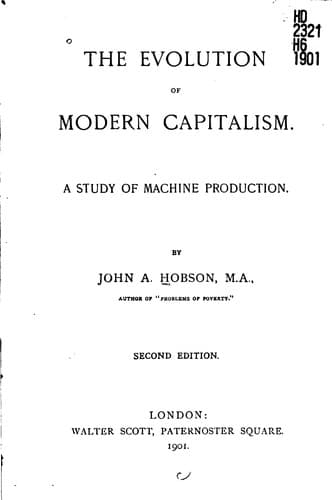
The Evolution of Modern Capitalism: A Study of Machine ProductionHobson, J. A. (John Atkinson)
History
The Evolution of Modern Capitalism: A Study of Machine Production
Hobson, J. A. (John Atkinson)
Capitalism; Industries -- History; Machinery in the workplace
(7) Lastly, the inferior mobility of woman as compared with man has an
influence in reducing the average efficiency of her labour. On the one
hand, women are more liable to have the locality of their home fixed
by the requirements of the male worker in the family; on the other
hand, they are physically less competent to undertake work far from
their home. Hence they are far more narrowly restricted in their
choice of work than men. They must often choose not that work they
like best, or can do best, or which is most remunerative, but that
which lies near at hand. This restriction implies that large numbers
of women undertake low-skilled, low-paid, ineffective, and irregular
work at their own homes or in some neighbouring work-room, instead of
engaging in the more productive and more remunerative work of the
large factories. Every limitation in freedom of choice of work
signifies a reduction in the average effectiveness of labour.
§ 6. These elements of inferior physique and manual skill, lower
intelligence and mental capacity, lack of education and knowledge of
life, irregularity of work, more restricted freedom of choice, must in
different degrees contribute to the inferior productivity of woman's
industrial labour.
In regarding this influence the experienced student of industrial
questions hardly requires to be reminded that these must be regarded
not merely as causes of low wages, but also as effects. This constant
recognition of the interaction of the phenomena we are regarding as
cause and effect is essential to a scientific conception of industrial
society. Women are paid low wages because they are relatively
inefficient workers, but they also are inefficient workers because
they are paid low wages.
While this smaller productivity diminishes the maximum wage attainable
by women as compared with men, it is evident that many forces are at
work which tend to equalise the productivity of men and women in
industry: the evolution of machinery adapted to the weaker physique of
women; the breakdown of customs excluding women from many occupations;
the growth of restrictions upon male adult labour with regard to the
working-day, etc., correspondent with those placed upon women;
improved mobility of women's labour by cheaper and more facile
transport in large cities; the recognition by a growing number of
women that matrimony is not the only livelihood open to them, but that
an industrial life is preferable and possible. These forces, unless
counteracted by stronger moral and social forces, seem likely to raise
the average productivity of women's industrial labour, and to incite
her more and more to undertake industrial wage-work.
Public-domain text, read in full here on John Shaqi.
Reviews
Reviews
No reviews yet
Be the first to share your thoughts on this work.
Elsewhere in the archive
Join the Discussion
Join the discussion
Sign in to leave a comment or review.
Sign InorCreate an account