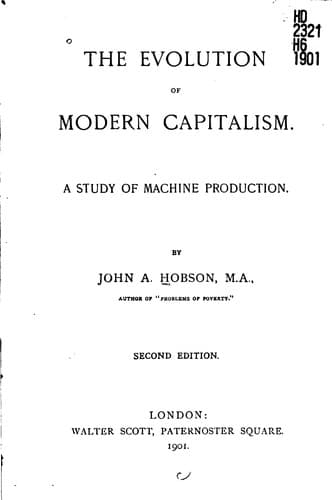
The Evolution of Modern Capitalism: A Study of Machine ProductionHobson, J. A. (John Atkinson)
History
The Evolution of Modern Capitalism: A Study of Machine Production
Hobson, J. A. (John Atkinson)
Capitalism; Industries -- History; Machinery in the workplace
§ 7. As the maximum wage may be said to vary with productivity, so the
minimum wage is said to vary with the "wants" of the worker. Women are
said to "want" less than man, and therefore the stress of competition
can drive their wages to a lower level. It is possible that a woman
can sustain the smaller quantity of physical energy required for her
work somewhat more cheaply than a man can sustain the energy required
for his work, and that the early increments of material comfort above
the bare subsistence line may be attended by a larger increase of
productivity in the man than in the woman. If this is so, then the
minimum subsistence wage and the wage of true economic efficiency, the
smallest wage a wise employer in his own interest will consent to pay,
are lower in the case of women than of men. But this difference
furnishes no adequate explanation of the difference between the male
and the female minimum wage. The wage of the low-skilled male labourer
enables him to consume certain things which do not belong strictly to
his "subsistence"--to wit, beer and tobacco; the wage of the
low-skilled female labourer often falls below what is sufficient with
the most rigid economy to provide "subsistence." We are not then
concerned with a difference which refers primarily to the quantity of
food, etc., required to support life. The wages of the low-skilled
labourer in regular employ would, if properly used, suffice to furnish
him more than a bare physical subsistence; the wages of the
lowest-paid women workers in factories would not suffice to maintain
them in the physical condition to perform their work.[251]
It is not then precisely with the "standard of comfort" of male and
female workers that we are concerned. The economic relation in which
men and women workers stand to other members of their family is a more
important factor. The wage of a male worker must be sufficient to
support not only himself but the average family dependent upon him, in
the standard of comfort below which he will not consent to work. When
little work is available for his wife and children, or where his
"standard of comfort" requires them not to undertake wage-work, his
minimum wage must suffice to keep some four persons. His standard of
comfort may be beaten down by stress of circumstances, his family may
be driven to take what work they can get, but in any case his wage
must be above the "subsistence" of a single man. When the man is the
sole wage-earner, or is only assisted slightly by his family, as, for
example, in the metal and mining and building industries, average male
wages are much higher than in the textile industries, where the women
and children share largely in the work.[252]
Public-domain text, read in full here on John Shaqi.
Reviews
Reviews
No reviews yet
Be the first to share your thoughts on this work.
Elsewhere in the archive
Join the Discussion
Join the discussion
Sign in to leave a comment or review.
Sign InorCreate an account