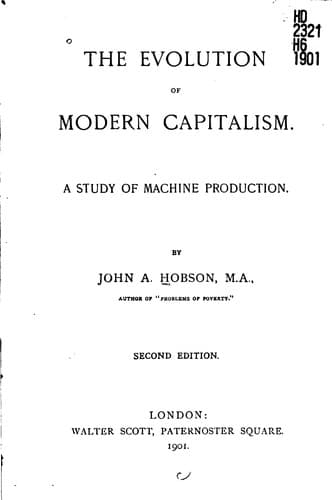
The Evolution of Modern Capitalism: A Study of Machine ProductionHobson, J. A. (John Atkinson)
History
The Evolution of Modern Capitalism: A Study of Machine Production
Hobson, J. A. (John Atkinson)
Capitalism; Industries -- History; Machinery in the workplace
Miss Collet's reply to the question is, that while the match and jam
girls pay the full price of home, board, and lodging, the others often
pay nothing, spending all they get upon dress and amusement. This,
taken along with the influence of the competition of home-workers in
the bookfolding and booksewing trades, explains the fact that the
harder and higher-skilled work gets no higher wages.
§ 10. A knowledge of the productivity of labour as measuring the
maximum wage-level, and of "wants" or standard of comfort as measuring
the minimum wage-level, does not enable us to determine even
approximately the actual wage-level in any industry. The actual wage
may be fixed at any point between the two extremes. So far as
competition is an active determinant, everything will depend upon the
quantitative relation between supply and demand for labour. When there
is a short supply of labour available for any work, wages may rise to
the maximum; when there is more labour available than is required,
wages will fall towards the minimum. But, as we have already admitted,
competition works very slowly and inadequately in many of the
industries in which women and children are engaged. The force of
custom, assisted by ignorance of the labour market, prevents women
from taking advantage of an increased demand or a decreased supply of
labour to lift this wage above the customary level towards the level
of productivity. Women are more contented to live as they have lived
than men. As Miss Collet says, "the contentment of women themselves,
when they have obtained enough for their standard of living, is
another reason why competition is so ineffective among highly-skilled
workers."[260]
This "contentment" or apathy, partly the result of ignorance, partly
the result of sex feebleness, enhanced by the exhausting burden of
present industrial conditions, is alluded to by the several reports of
the sub-commissioners to the Labour Commission as a chief difficulty
in the effective organisation of women workers, even when the work is
conducted in large factories.
In other ways, woman is less of a purely "economic" creature than man.
The flow of labour from one occupation to another, which tends to
equalise the net advantages amongst male occupations, is far feebler
among women workers, notwithstanding that trade union barriers and the
vested interests of expensively-acquired skill are less operative in
woman's work. The reluctance of women to freely communicate to one
another facts regarding their wage and conditions of labour is
particularly noted as a barrier to united action.
Public-domain text, read in full here on John Shaqi.
Reviews
Reviews
No reviews yet
Be the first to share your thoughts on this work.
Elsewhere in the archive
Join the Discussion
Join the discussion
Sign in to leave a comment or review.
Sign InorCreate an account