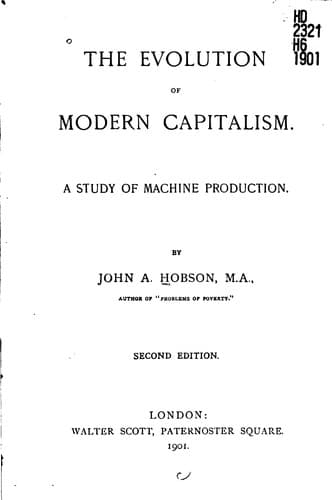
The Evolution of Modern Capitalism: A Study of Machine ProductionHobson, J. A. (John Atkinson)
History
The Evolution of Modern Capitalism: A Study of Machine Production
Hobson, J. A. (John Atkinson)
Capitalism; Industries -- History; Machinery in the workplace
Those who have investigated the conditions of women workers in towns
are agreed as to the enormous influence of class and æsthetic feelings
in narrowing the competition. "The girl who makes seal-skin caps at a
city warehouse does not wish to work for an East End chamber-master,
even though she could make more at the commoner work; just as a
soap-box maker would not care to make match-boxes, even though skilled
enough to make more by it."[261] This sensitiveness of social
distinction in industrial work, based partly upon consideration of the
class and character of those employed, partly upon the skill and
interest of the work itself, is a widespread and powerful influence
among women workers. It tends to bring about that equalisation of
wages in skilled and unskilled industries which, as we have seen,
practically exists, for if there is an economic rise of wages in the
lower grades of work, it does not tempt the competition of
high-skilled workers, while a corresponding rise in the wages of the
higher grades would draw competitors from the lower grades to qualify
themselves for undertaking work which would at once give them more
money and more social respect. The lower wages often paid for more
highly-skilled work simply mean that the women take out a larger
portion of their wage in "gentility." This influence, which is
operative amongst men, reducing the wages of routine-mental labour to
the level of common unskilled manual labour, is powerful in all ranks
of women, rising perhaps in its potency with the social status of the
woman. Considerations of "gentility" enable us to obtain "teachers"
for board schools at an average "salary" of £75 per annum, as compared
with £119 for men, the fixed scale of women teachers in the same grade
being 16 per cent. less than for men.
Thus custom, ignorance, contentment, social prejudices operate in
different ways and in different degrees to prevent women workers from
claiming in higher wages that share of the increased capacity of the
community for making wealth which men workers have been able to
procure.
Public-domain text, read in full here on John Shaqi.
Reviews
Reviews
No reviews yet
Be the first to share your thoughts on this work.
Elsewhere in the archive
Join the Discussion
Join the discussion
Sign in to leave a comment or review.
Sign InorCreate an account