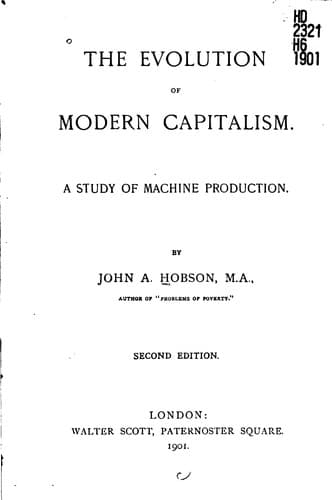
The Evolution of Modern Capitalism: A Study of Machine ProductionHobson, J. A. (John Atkinson)
History
The Evolution of Modern Capitalism: A Study of Machine Production
Hobson, J. A. (John Atkinson)
Capitalism; Industries -- History; Machinery in the workplace
would, if there were absolute equality of competition and absolute
fluidity of labour, be measured at say 3s. It is true that no such
measurement is open to us, and all such estimates are guesswork. But
the idea which underlies the sentiment against "sweating" is a true
one, although it has no exact practical embodiment so long as our only
meaning of "value" is value in exchange at present competitive rates.
It is therefore not inaccurate to represent productivity as forming
the maximum wage, though we may have no exact measure of productivity
at hand. The fact that any increase in productivity of labour is
liable under certain circumstances of competition to pass away
entirely to the consumer, is no reason for denying that an increase of
productivity has taken place which might under other circumstances of
competition have gone to the producer as higher wages. Though
productivity as a measure of maximum wages is more or less of an
unknown quantity, it is none the less true that as this "unknown"
fluctuates so the possibility of high wages fluctuates.
§ 14. If the above analysis is correct it is not difference of sex
which is the chief factor in determining the industrial position of
woman. Machinery knows neither sex nor age, but chooses the labour
embodied in man, woman, or child, which is cheapest in relation to the
degree of its efficiency. Thus the causes which depress woman's
industry are chiefly the same which depress the industry of
low-skilled men and children. In each case the limits of productivity
and "wants" are lower than for skilled men workers, while the terms of
their competition keep their wages to the lower level and check the
full incentive to efficiency. Setting aside the case of children, who
are protected in some degree from the full effects of competition upon
the conditions of their employment, the industrial case of women is
closely analogous to that of low-skilled men. The physical weakness of
the one corresponds with the technical weakness of the other so far as
efficiency is concerned; in both cases the low standard of wants gives
a low minimum wage, while the excessive supply of labour, rendering
concerted action almost impossible, keeps wages close to the minimum.
Public-domain text, read in full here on John Shaqi.
Reviews
Reviews
No reviews yet
Be the first to share your thoughts on this work.
Elsewhere in the archive
Join the Discussion
Join the discussion
Sign in to leave a comment or review.
Sign InorCreate an account