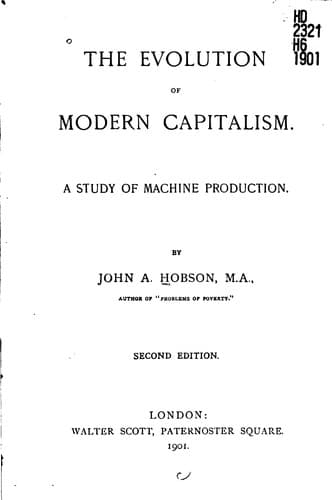
The Evolution of Modern Capitalism: A Study of Machine ProductionHobson, J. A. (John Atkinson)
History
The Evolution of Modern Capitalism: A Study of Machine Production
Hobson, J. A. (John Atkinson)
Capitalism; Industries -- History; Machinery in the workplace
§ 15. The displacement of male adult labour which is going on by
female, and, when permitted, by child labour, does not necessarily
imply that women and children are doing more work and men less than
they used to do. Before the industrial revolution women were quite as
busily and numerously engaged in industry as now, and the children
employed in textile and other work were often worked in their own
homes with more cruel disregard to health and happiness than is now
the case. Even now the longest hours, the worst sanitary conditions,
the lowest pay, are in the domestic industries of towns which still
survive under modern industry. But though the regular factory women
and the half-timers are generally better off in all the terms of their
industry than the uninspected women and children who still slave in
such domestic industries as the trimmings and match-box trades, the
growing tendency of modern industry to engage women and children away
from their homes is fraught with certain indirect important
consequences. When industry was chiefly confined to domestic
handicrafts, the claims of home life constantly pressed in and
tempered the industrial life. The growth of factory work among women
has brought with it inevitably a weakening of home interests and a
neglect of home duties. The home has suffered what the factory has
gained. Even the shortening of the factory day, accompanied as it has
been by an intensification of labour during the shorter hours, does
not leave the women competent and free for the proper ordering of home
life. Home work is consciously slighted as secondary in importance and
inferior, because it brings no wages, and if not neglected is
performed in a perfunctory manner, which robs it of its grace and
value. This narrowing of the home into a place of hurried meals and
sleep is on the whole the worst injury modern industry has inflicted
on our lives, and it is difficult to see how it can be compensated by
any increase of material products. Factory life for women, save in
extremely rare cases, saps the physical and moral health of the
family. The exigencies of factory life are inconsistent with the
position of a good mother, a good wife, or the maker of a home. Save
in extreme circumstances, no increase of the family wage can balance
these losses, whose values stand upon a higher qualitative level.
Public-domain text, read in full here on John Shaqi.
Reviews
Reviews
No reviews yet
Be the first to share your thoughts on this work.
Elsewhere in the archive
Join the Discussion
Join the discussion
Sign in to leave a comment or review.
Sign InorCreate an account