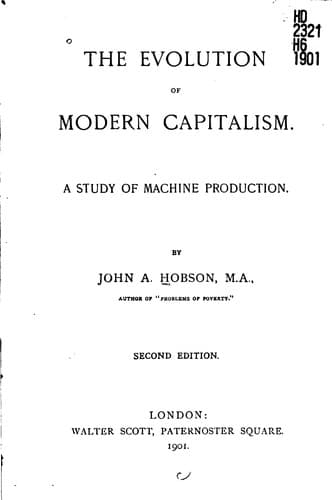
The Evolution of Modern Capitalism: A Study of Machine ProductionHobson, J. A. (John Atkinson)
History
The Evolution of Modern Capitalism: A Study of Machine Production
Hobson, J. A. (John Atkinson)
Capitalism; Industries -- History; Machinery in the workplace
The direct economic tendency of machine-industry to take women and
children away from the home to work must be looked upon as a tendency
antagonistic to civilisation.[265] In the case of children, factory
legislation of increasing severity has been necessary to prevent the
spread or continuance of the evil.[266] The factory regulations
restricting and protecting women are directly continuous with this
policy, and may be regarded in the light of a protection of the home
against the undue encroachments of the machine. How far further
restrictions may be left to voluntary action and the growth of a saner
estimate of values, or how far further legal protection of the home
may be required, it remains for history to determine.
APPENDIX.
The following Table of Factory Legislation is constructed to
illustrate the lines along which State protection of labour has
advanced in this century in England. Four laws of development are
clearly discernible:--
1. Movement along the line of strongest human feeling. Weakest
workers are protected first, pauper children who are the
least "free" parties in a contract, then protection
advances to other children, young persons, women, men.
2. Protective legislation moves from the more highly organised
to the less highly organised structures of industry.
Cotton-mills are sole subjects of earliest Factory Acts,
then woollen, then other textile trades, trades subsidiary
to textile industries, non-textile factories, larger
workshops, domestic workshops, retail trade, domestic
service.
3. Growing complexity of aims and of legislative machinery.
Primarily Factory Acts aim at regulation of quantity of
labour. Reductions of the working-day forms a backbone of
this legislation. A twelve-hour day, ten, nine, eight,
covering wider classes of workers and applied to a larger
number of industries, marks the line of movement. With each
advance the basis of protection is broadened, other
considerations of machine-fencing, sanitation, education,
etc., entering more largely into the Acts.
4. Increased effectiveness of legislation with growth of
centralised control. Local initiative and control proves
ineffective, yields to State inspection, the number of
inspectors growing, and their power increasing. Improvements
in the mechanism of central control, an increased number of
inspectors, working men and women inspectors, are the
distinguishing features of recent State protection of
labour.
LEADING POINTS IN THE DEVELOPMENT OF FACTORY LEGISLATION.
Public-domain text, read in full here on John Shaqi.
Reviews
Reviews
No reviews yet
Be the first to share your thoughts on this work.
Elsewhere in the archive
Join the Discussion
Join the discussion
Sign in to leave a comment or review.
Sign InorCreate an account