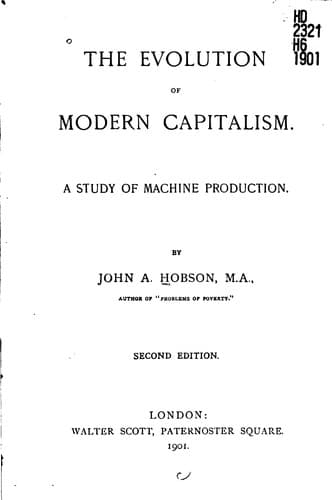
The Evolution of Modern Capitalism: A Study of Machine ProductionHobson, J. A. (John Atkinson)
History
The Evolution of Modern Capitalism: A Study of Machine Production
Hobson, J. A. (John Atkinson)
Capitalism; Industries -- History; Machinery in the workplace
[249] Women sometimes abuse the superior competitive powers contained
in their lower standard of subsistence, and the smaller number of
those dependent on them, to undersell male labour. In Sheffield
file-making, where women are paid the same list of prices as men, it
is said that they practise sweating in their homes to the detriment of
male workers. So in carpet-weaving at Halifax; recently when the men
struck against a reduction upon their wage of 35s., women took the
work at 20s. (Lady Dilke, "Industrial Position of Women," _Nineteenth
Century_, Oct. 1893.) In watch-making, "the hand-work for which men
were paid about 18s. a-week is now done by women with machinery for
about 12s." (_Report to Labour Commission on Women's Employments_, p.
146.)
[250] Dr. Bertillon (_Journal de la Société de Statistique de Paris_,
Oct.-Nov. 1892) shows that among the Lyons silkworkers (1872-89) and
in the Italian Societies (1881-85) the sickness of women is
considerably greater than of men. In Lyons 9.39 days as compared with
7.81 for men; in Italy 8.5 as compared with 6.6.
[251] This holds, for example, of many branches of the fur, trimmings,
stays, umbrella, match-box trades, and the "finishing" departments of
the trousers and shirt trades in East London. Cf. Miss Collet in
_Labour and Life of the People_, vol. i.
[252] In the United States the general standard of money wages for
working women in cities is considerably higher than in England. The
average wage throughout the country was recently estimated to amount
to $5.24 per week, or just under 21s. But the divergences from this
average are much wider than in England. The lowest wages fall almost
to the lowest English level, for some 3 per cent. of the number
averaged were earning less than 8s. a week. About 20 per cent. were
earning between 14s. and 19s. per week. The earnings in the chief
textile industries show wide variations, yielding, however, a rough
average of about 20s. weekly wages in cotton mills, and about 22s. in
woollen mills. A general comparison would yield a standard of some
15s. as the customary wage corresponding to the 10s. in England
(_Report of the Commissioner of Labour_, 1888, chap. iii. and Table
xxix.). Some allowance, however, must be made for the more expensive
living in American cities. However, in spite of the fact that
organised action is almost unknown among women workers in America, the
real wages are higher than in England. This is partly owing to the
general insistence upon a higher standard of consumption, partly to
the fact that a larger number of employments are open to women than in
England, and partly to the higher skill and intelligence they put into
their work. Thus the maximum wage, measured by productivity, is
higher, the minimum, measured by "wants," is higher, while the terms
of competition do not so generally keep down actual wages to the
minimum.
[253] _Labour and Life of the People_, vol. i. p. 410.
Public-domain text, read in full here on John Shaqi.
Reviews
Reviews
No reviews yet
Be the first to share your thoughts on this work.
Elsewhere in the archive
Join the Discussion
Join the discussion
Sign in to leave a comment or review.
Sign InorCreate an account