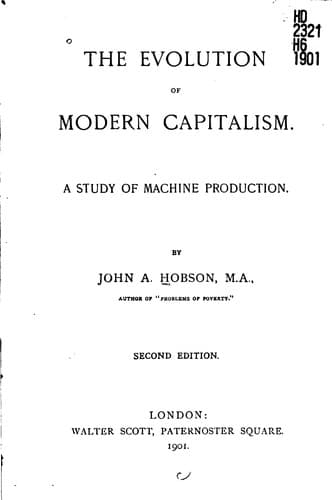
The Evolution of Modern Capitalism: A Study of Machine ProductionHobson, J. A. (John Atkinson)
History
The Evolution of Modern Capitalism: A Study of Machine Production
Hobson, J. A. (John Atkinson)
Capitalism; Industries -- History; Machinery in the workplace
[254] It must, however, be borne in mind that the results of such a
policy followed by Lancashire, or any other single part of the textile
industry of the world, would be qualified or even negatived if the
example was not followed by their competitors.
[255] This effect of industrial opportunities for women and children
in promoting early and more fruitful marriages is also illustrated in
Lancashire; the average family of the factory operative is
considerably higher than the average for the working classes as a
whole.
[256] Gunton, _Wealth and Progress_, p. 169.
[257] _Report of the Statistics of Labour_, p. 71.
[258] Dr. Smart has a valuable treatment of the subject in his
pamphlet, _Women's Wages_, pp. 22-25.
[259] _Labour and Life of the People_, vol. i. p. 469.
[260] _Labour and Life of the People_, vol. i. p. 460.
[261] _Ibid._, vol. i. p. 459; cf. also p. 469.
[262] Smart, _Woman's Wages_, p. 23.
[263] In some cases where women are found getting the same rate of
wages as men, the industry is a woman's industry in which a few
lower-skilled or inferior male workers are employed. The woman's scale
dominates, the men who are employed descending to it. This is the case
in some weaving trades where men work still almost entirely with
hand-looms, leaving women with a practical monopoly of power-loom
work. (_Report of Woollen Manufactures in Miscellaneous English
Towns_, pp. 98, 99.) Where both men and women are freely engaged in
the same class of work, the men are always (save in the area of the
Lancashire trade unions) paid at higher rates: where the same rates
are paid they are determined upon the woman's scale. The comparison
between Huddersfield and other cloth-making towns in Yorkshire
establishes this point. "In the cloth mills of these three districts,
Bradford, Huddersfield, and Leeds, men and women engaged upon the same
work at the looms receive the same pay. In the Huddersfield district
the proportion of men to women among the weavers is much greater than
it is in the districts of Bradford, Halifax, or Leeds, and in the
Huddersfield districts alone there is a weaver's scale, according to
which women are paid from 15 to 50 per cent. below men. The proportion
of women is, however, rapidly increasing; and I found many firms where
the scale is not in operation. At some places men and women were paid
alike _upon the woman's scale_. At other firms men were paid at a
slightly higher rate than women, the women's scale being the basis of
calculation for all classes of work." (Miss Abraham in _Reports on
Employment of Women to the Labour Commission_, p. 100.)
[264] _Report on Principal Textile Trades_, p. xxv.
[265] The evidence adduced by Dr. Arlidge in his _Diseases of
Occupations_ regarding the effects of factory life upon the physique
of children is conclusive. See p. 38, etc.
[266] See Appendix on Factory Legislation.
CHAPTER XIII.
MACHINERY AND THE MODERN TOWN.
Public-domain text, read in full here on John Shaqi.
Reviews
Reviews
No reviews yet
Be the first to share your thoughts on this work.
Elsewhere in the archive
Join the Discussion
Join the discussion
Sign in to leave a comment or review.
Sign InorCreate an account